

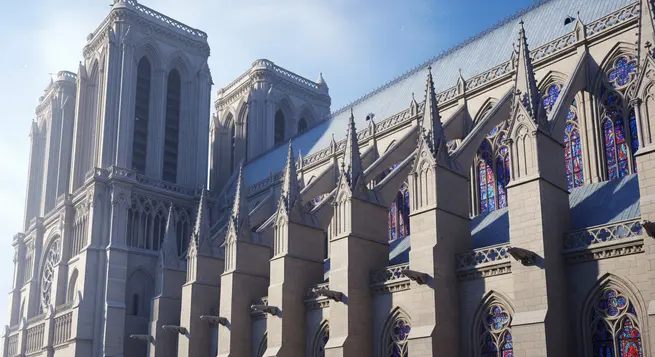
Gothic cathedrals are famous for their sheer height and skeletal stone frames. At the heart of this structural revolution were flying buttresses, which allowed medieval builders to construct soaring walls of glass.
This quiz focuses on the mechanics and history of these innovations. You will find questions about structural forces, the role of stone pinnacles, and iconic sites like Chartres and Notre-Dame.
After testing your knowledge, you can explore other architectural styles, read about famous buildings, or learn about minor architectural details.
Which architectural style is most famously associated with the development and use of flying buttresses?
Byzantine
Byzantine
Gothic
Gothic
Romanesque
Romanesque
Classical Greek
Classical Greek
What is the primary structural function of a flying buttress?
To increase the size of the cathedral crypt
To increase the size of the cathedral crypt
To provide support for heavier roofs
To provide support for heavier roofs
To transfer outward thrust from walls to external piers
To transfer outward thrust from walls to external piers
To store rainwater for the cathedral grounds
To store rainwater for the cathedral grounds
How did the introduction of the flying buttress transform the appearance of cathedral walls?
Windows became narrower for better security
Windows became narrower for better security
Windows were eliminated entirely in favor of stone carvings
Windows were eliminated entirely in favor of stone carvings
Walls became thicker and heavier to support the roof
Walls became thicker and heavier to support the roof
Walls could be built thinner and higher with expansive window space
Walls could be built thinner and higher with expansive window space
What is the name of the vertical stone ornament often placed on top of the outer pier of a flying buttress to add weight and counter lateral forces?
The Vault
The Vault
The Foundation
The Foundation
The Pinnacle
The Pinnacle
The Archway
The Archway
Which famous cathedral featured some of the earliest and most iconic flying buttresses in its original 12th-century design?
Notre-Dame de Paris
Notre-Dame de Paris
Cologne Cathedral
Cologne Cathedral
Chartres Cathedral
Chartres Cathedral
Amiens Cathedral
Amiens Cathedral
By removing the weight-bearing requirement from the main walls, flying buttresses allowed for the installation of what prominent feature?
Wooden reinforcement bars
Wooden reinforcement bars
Marble statues
Marble statues
Iron support beams
Iron support beams
Stained glass windows
Stained glass windows
Which Gothic masterpiece in France utilizes flying buttresses to reach a height of approximately 37 meters in its nave?
Chartres Cathedral
Chartres Cathedral
Salisbury Cathedral
Salisbury Cathedral
Milan Cathedral
Milan Cathedral
Westminster Abbey
Westminster Abbey
What is the distinction between the two primary structural components of a flying buttress?
The anchor sits on the roof, while the decorative statuette sits on the top
The anchor sits on the roof, while the decorative statuette sits on the top
The internal column supports the roof, while the outside wall reinforcement holds the window
The internal column supports the roof, while the outside wall reinforcement holds the window
The arched portion spans the open space, while the pier is the heavy vertical support
The arched portion spans the open space, while the pier is the heavy vertical support
They are two different names for the exact same stone block
They are two different names for the exact same stone block
What is the scientific benefit of the weight provided by a stone pinnacle on a buttress?
To hold up the flying buttress against wind pressure
To hold up the flying buttress against wind pressure
To create a vertical load that directs the lateral thrust downward into the ground
To create a vertical load that directs the lateral thrust downward into the ground
To provide extra aesthetic beauty for tourists
To provide extra aesthetic beauty for tourists
To prevent water from seeping into the arched joints
To prevent water from seeping into the arched joints
How did flying buttresses impact the construction of Gothic cathedral walls?
They required the walls to be significantly thicker than Romanesque ones
They required the walls to be significantly thicker than Romanesque ones
They allowed the walls to be built much thinner and taller
They allowed the walls to be built much thinner and taller
They allowed for the omission of interior support columns in the nave
They allowed for the omission of interior support columns in the nave
They forced the walls to be built of lighter wood rather than stone
They forced the walls to be built of lighter wood rather than stone
Which technical factors determine the structural stability of a flying buttress design?
The color of the stone, the artist’s signature, and the foundation depth
The color of the stone, the artist’s signature, and the foundation depth
The orientation towards Mecca, the height of the spire, and the thickness of the stained glass
The orientation towards Mecca, the height of the spire, and the thickness of the stained glass
The arch height, the angle of the flyer, and the mass of the outer pier
The arch height, the angle of the flyer, and the mass of the outer pier
The wood for the scaffolding, the number of bells, and the floor mosaic pattern
The wood for the scaffolding, the number of bells, and the floor mosaic pattern
What specific force do flying buttresses primarily counteract?
The internal pressure of a bell tower collapse
The internal pressure of a bell tower collapse
The horizontal outward force of the ribbed vault roof
The horizontal outward force of the ribbed vault roof
The necessity of balancing the floor load on uneven soil
The necessity of balancing the floor load on uneven soil
The need to protect the cathedral from invading armies
The need to protect the cathedral from invading armies
Beyond structural support, what practical utility do the platforms of flying buttresses sometimes offer?
To increase the interior acoustic projection for choral singing
To increase the interior acoustic projection for choral singing
To reduce the total amount of stone needed for the building construction
To reduce the total amount of stone needed for the building construction
To protect the structure from shifting due to wind and ground vibration
To protect the structure from shifting due to wind and ground vibration
To provide a walkway for workers to reach the upper roofs for repairs
To provide a walkway for workers to reach the upper roofs for repairs
Why was the transition to flying buttresses considered an evolution in architecture?
They were only used in churches that lacked stained glass windows
They were only used in churches that lacked stained glass windows
Early Gothic cathedrals often relied on thick walls to support vaults until architects began pushing for taller structures and more window light
Early Gothic cathedrals often relied on thick walls to support vaults until architects began pushing for taller structures and more window light
Romanesque architecture used them extensively as well
Romanesque architecture used them extensively as well
They were invented by the ancient Egyptians for pyramid stability
They were invented by the ancient Egyptians for pyramid stability
What happens if a high nave wall is built upon slender piers without external support?
The lateral pressure would push the walls outward, leading to collapse
The lateral pressure would push the walls outward, leading to collapse
The height would cause the foundation to sink unevenly into the ground
The height would cause the foundation to sink unevenly into the ground
Without side support, the building would suffer from severe water drainage issues
Without side support, the building would suffer from severe water drainage issues
The roof would become too heavy for the central pillars to support alone
The roof would become too heavy for the central pillars to support alone
What is a ‘hidden buttress’ in the context of medieval church architecture?
A reinforced foundation pier buried entirely below the floor level of the nave
A reinforced foundation pier buried entirely below the floor level of the nave
A decorative pilaster built into the interior walls of the crypt
A decorative pilaster built into the interior walls of the crypt
A temporary wooden framework used only during the construction of the vault
A temporary wooden framework used only during the construction of the vault
An arched support concealed under the sloping roof of a side aisle or gallery
An arched support concealed under the sloping roof of a side aisle or gallery
Which statement best describes the path of force in a flying buttress system?
The flying buttress absorbs the lateral thrust of the vault and channels it down to a heavy external pier
The flying buttress absorbs the lateral thrust of the vault and channels it down to a heavy external pier
The flying buttress acts primarily as a lightning rod to protect the cathedral tower
The flying buttress acts primarily as a lightning rod to protect the cathedral tower
The flying buttress stabilizes the floor to prevent cracking from heavy foot traffic
The flying buttress stabilizes the floor to prevent cracking from heavy foot traffic
The flying buttress transfers the weight of the gargoyles directly to the foundation walls
The flying buttress transfers the weight of the gargoyles directly to the foundation walls
Which of the following represents the primary lateral force exerted by a stone vault on the high walls of a Gothic nave?
An inward suction that pulls the walls toward the center of the nave
An inward suction that pulls the walls toward the center of the nave
A rotational twisting force that spins the columns on their bases
A rotational twisting force that spins the columns on their bases
A purely vertical upward lift that reduces the total weight on the pillars
A purely vertical upward lift that reduces the total weight on the pillars
An outward thrust that pushes the top of the walls outward
An outward thrust that pushes the top of the walls outward
What is a notable structural and visual feature of the flying buttresses of Chartres Cathedral?
They were added centuries later during a French Revolution-era reconstruction
They were added centuries later during a French Revolution-era reconstruction
They feature a double-tiered system connected by a radial arcade resembling the spokes of a wheel
They feature a double-tiered system connected by a radial arcade resembling the spokes of a wheel
They are completely hidden from the outside of the building within the thick clerestory walls
They are completely hidden from the outside of the building within the thick clerestory walls
They were designed to be purely decorative and carry no actual weight from the vaults
They were designed to be purely decorative and carry no actual weight from the vaults
How do gargoyles functionally differ from buttresses in Gothic cathedrals?
A buttress supports the roof trusses, while a gargoyle carries the load of the foundation walls
A buttress supports the roof trusses, while a gargoyle carries the load of the foundation walls
Gargoyles are heavy stone blocks used solely to weight down and stabilize the buttress pier
Gargoyles are heavy stone blocks used solely to weight down and stabilize the buttress pier
A gargoyle is a waterspout designed for drainage, while a buttress is a structural support member
A gargoyle is a waterspout designed for drainage, while a buttress is a structural support member
Gargoyles and buttresses are identical architectural features with different names
Gargoyles and buttresses are identical architectural features with different names
How did the pointed arch interact with the flying buttress to stabilize Gothic structures?
Pointed arches were only used for windows and had no effect on structural loading
Pointed arches were only used for windows and had no effect on structural loading
Pointed arches are weaker and forced architects to create flying buttresses as a quick fix
Pointed arches are weaker and forced architects to create flying buttresses as a quick fix
The shift from rounded arches to pointed arches changed how weight was distributed downwards
The shift from rounded arches to pointed arches changed how weight was distributed downwards
Pointed arches eliminated the need for any buttresses at all
Pointed arches eliminated the need for any buttresses at all
In a functional sense, what role does the connection point between the wall and the flying buttress play?
It helps keep the vault from spreading outward by channeling force into the arched flyer
It helps keep the vault from spreading outward by channeling force into the arched flyer
It reduces the number of monks needed to perform daily prayers in the cathedral
It reduces the number of monks needed to perform daily prayers in the cathedral
It prevents the ground under the cathedral from shifting during heavy rains
It prevents the ground under the cathedral from shifting during heavy rains
It keeps the choir area separate from the public area of the church
It keeps the choir area separate from the public area of the church
You can do better
Not bad
Great!
Next, try trivia on sacred architecture, discover UNESCO sites, or explore historic places.