

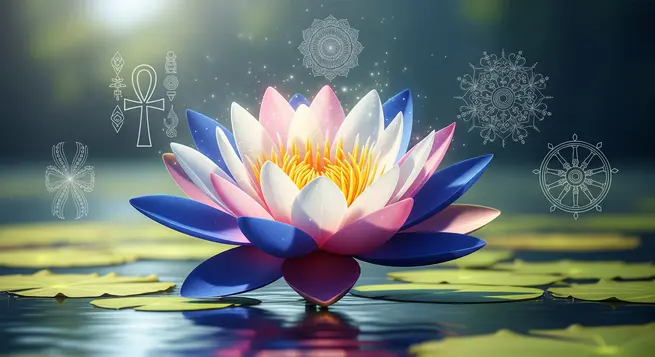
The lotus flower holds a special place in cultural history, admired for blooming in muddy waters while remaining perfectly pristine. For thousands of years, different cultures have used this quiet botanical wonder to explain deep spiritual truths.
This trivia quiz looks at how the flower appears across different traditions. You will answer questions about ancient Egyptian mythology, Hindu and Buddhist iconography, and the science behind the plant’s self-cleaning leaves.
After finishing, you can read about other iconographies in art symbols, find out how spiritual ideas shape sacred architecture, or explore unique traditions through regional art.
In which cultures is the lotus frequently used as a symbol of purity?
Eastern cultures
Eastern cultures
Norse cultures
Norse cultures
Inuit cultures
Inuit cultures
Mayan cultures
Mayan cultures
The lotus is often celebrated for its ability to bloom beautifully despite growing in what type of environment?
Rocky mountains
Rocky mountains
Muddy water
Muddy water
Clear mountain streams
Clear mountain streams
Desert sand
Desert sand
In which ancient culture was the lotus often associated with the sun god and the cycle of rebirth?
Greek mythology
Greek mythology
Inuit traditions
Inuit traditions
Scandinavian folklore
Scandinavian folklore
Egyptian mythology
Egyptian mythology
In which tradition is the goddess Lakshmi often depicted sitting on a large lotus flower?
Shintoism
Shintoism
Zoroastrianism
Zoroastrianism
Hinduism
Hinduism
Judaism
Judaism
In Buddhism, the unfolding petals of the lotus often symbolize the soul’s expansion and the path to what ultimate spiritual goal?
Temporal power
Temporal power
Nirvana
Nirvana
The afterlife
The afterlife
Material wealth
Material wealth
According to Hindu belief, which part of the lotus is often associated with the Divine center or the spiritual core of a person?
The heart
The heart
The roots
The roots
The eyes of the Buddha
The eyes of the Buddha
The petals
The petals
Which specific color of the lotus was highly sacred in ancient Egypt and often used in religious art?
Striped
Striped
Black
Black
Orange
Orange
Blue
Blue
Botanically, why is the lotus surface considered a perfect symbol for purity?
It is hydrophobic
It is hydrophobic
It stays dirty
It stays dirty
It absorbs all light
It absorbs all light
It attracts dust
It attracts dust
In Hindu cosmology, who is often depicted as having been born from a lotus emerging from the navel of another deity?
Ganesha
Ganesha
Vishnu
Vishnu
Brahma
Brahma
Shiva
Shiva
In Buddhist iconography, where is the lotus commonly visualised as a base or pedestal for the Buddha or Bodhisattvas?
As a crown for the worshippers
As a crown for the worshippers
The base or throne of a deity figure
The base or throne of a deity figure
The floor of the temple
The floor of the temple
The entrance gate of the garden
The entrance gate of the garden
Emphasizing the universal possibility of enlightenment, the highly influential scripture named after this sacred flower belongs to which major branch of Buddhism?
Theravada
Theravada
Mahayana
Mahayana
Vajrayana
Vajrayana
Hinayana
Hinayana
In Buddhist art, which color of this sacred flower specifically represents mental purity and the state of being spiritually perfected (bodhi)?
Blue
Blue
White
White
Purple
Purple
Red
Red
Why did the ancient Egyptians associate the daily opening and closing of the lotus petals with the sun?
The migration of birds each autumn month
The migration of birds each autumn month
The sun rising from the river each day
The sun rising from the river each day
The flooding of the Nile each year
The flooding of the Nile each year
The sun setting in the west
The sun setting in the west
The lotus motif became a pervasive decorative element in which art form during the Ming Dynasty?
Imperial Chinese porcelain
Imperial Chinese porcelain
Japanese woodblock prints
Japanese woodblock prints
Korean celadon pottery
Korean celadon pottery
Persian miniature painting
Persian miniature painting
In yogic or tantric iconography, the thousand-petaled lotus is frequently used to represent which spiritual energy center?
The third eye chakra
The third eye chakra
The throat chakra
The throat chakra
The crown chakra
The crown chakra
The heart chakra
The heart chakra
Although historically conflated in many ancient art traditions, the sacred ‘lotus’ of Indian art is botanically closer to which aquatic plant?
Hibiscus
Hibiscus
Water lily
Water lily
Orchid
Orchid
Tulip
Tulip
Which figure in Buddhist art is frequently depicted holding a lotus, with a name that literally translates to ‘lotus-bearer’?
Vajrapani
Vajrapani
Maitreya
Maitreya
Padmapani
Padmapani
Manjushri
Manjushri
What does the progression of a lotus from a closed bud to a fully opened flower symbolize in Eastern iconography?
To count the number of days in the month
To count the number of days in the month
To mark the seasons for farming
To mark the seasons for farming
To represent the harshness of life
To represent the harshness of life
To represent the stages of a person’s life towards wisdom
To represent the stages of a person’s life towards wisdom
The national flower of which of these nations is the lotus?
Japan
Japan
Thailand
Thailand
India
India
France
France
Lotus motifs have been unearthed in the remains of which ancient civilization, predating later Buddhist and Hindu artistic traditions?
Indus Valley civilization
Indus Valley civilization
Hittite Empire
Hittite Empire
Minoan civilization
Minoan civilization
Akkadian Empire
Akkadian Empire
Beyond purity, what major philosophical concept does the lotus represent in the Bhagavad Gita regarding human action?
Wealth and harvest
Wealth and harvest
Detachment from worldly desires
Detachment from worldly desires
Royal lineage and dynasty
Royal lineage and dynasty
Warfare and defense
Warfare and defense
In the transition from Vedic to post-Vedic times, where was the lotus most prominently featured as a religious symbol in Indian architecture?
Terracotta bricks and floors
Terracotta bricks and floors
Wooden pillars and ceilings
Wooden pillars and ceilings
Thatch roofs and mud walls
Thatch roofs and mud walls
Stone carvings and temple reliefs
Stone carvings and temple reliefs
You can do better
Not bad
Great!
If you enjoyed these questions, browse our trivia about historic places, study sacred themes in ancient sculpture, or read up on unique natural wonders around the globe.