

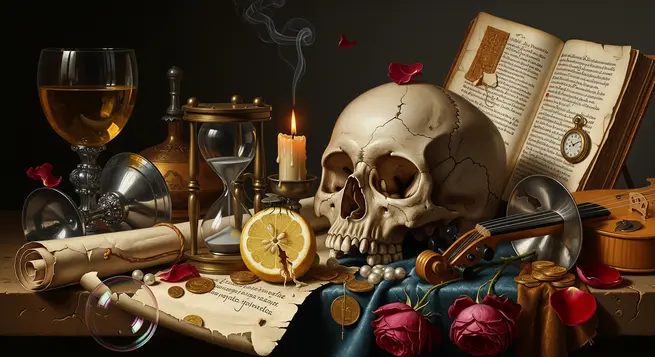
Vanitas paintings are some of the most striking works of the Dutch Golden Age, filled with quiet reminders of mortality. These still lifes use everyday items to urge viewers to think about life, death, and time.
This quiz looks at the meanings behind common symbols like skulls, bubbles, and hourglasses. You will see questions about the famous artists who mastered this style and the cultural beliefs that shaped their artwork.
When you finish, you can learn about other art movements, look into classic symbols in art, or read about famous artists.
What is a “vanitas” painting?
A landscape depicting a battlefield
A landscape depicting a battlefield
A portrait of a wealthy merchant
A portrait of a wealthy merchant
A painting showcasing the luxury of royal life
A painting showcasing the luxury of royal life
A still life painting intended to remind the viewer of their own mortality
A still life painting intended to remind the viewer of their own mortality
In art history, what does the presence of a skull commonly symbolize in a still life composition?
The fleeting nature of life
The fleeting nature of life
Wealth and prosperity
Wealth and prosperity
Eternal friendship
Eternal friendship
The triumph of science
The triumph of science
In the context of vanitas art, what is the primary symbolic meaning of an hourglass?
The value of gold
The value of gold
The precision of the artist
The precision of the artist
The importance of sleeping habits
The importance of sleeping habits
The passage of time
The passage of time
Which element is frequently included in vanitas paintings to represent the transience of life and physical beauty?
An intricate, growing vine
An intricate, growing vine
A wilting or decaying flower
A wilting or decaying flower
A sturdy, potted evergreen tree
A sturdy, potted evergreen tree
A beautiful, fresh bouquet of lilies
A beautiful, fresh bouquet of lilies
In which region did the “vanitas” genre reach its peak in popularity during the 17th century?
Italy
Italy
France
France
The Dutch Republic
The Dutch Republic
Spain
Spain
Which of these objects is commonly used in vanitas still lifes to signify that a life has recently ended?
A reflection in a crystal vase
A reflection in a crystal vase
A brightly shined metal dish
A brightly shined metal dish
A snuffing candle or smoke trail
A snuffing candle or smoke trail
A bubbling fountain
A bubbling fountain
When artists included musical instruments or books in a vanitas painting, what was the intended message?
Greed and gluttony
Greed and gluttony
The importance of military conquest
The importance of military conquest
The necessity of hard work and labor
The necessity of hard work and labor
The transience of earthly knowledge and fleeting pleasures
The transience of earthly knowledge and fleeting pleasures
The high degree of realism and microscopic detail in Dutch Golden Age vanitas paintings is most closely tied to which artistic tradition?
The Italian Mannerist style
The Italian Mannerist style
The English Neo-Classical school
The English Neo-Classical school
The Northern Renaissance approach to detail
The Northern Renaissance approach to detail
The French Baroque movement
The French Baroque movement
Which Dutch artist is highly celebrated for his precise, atmospheric still life paintings that often incorporated vanitas themes?
Frans Hals
Frans Hals
Pieter Claesz
Pieter Claesz
Rembrandt van Rijn
Rembrandt van Rijn
Johannes Vermeer
Johannes Vermeer
What Latin phrase, meaning “remember you must die,” is most closely associated with the philosophy behind vanitas art?
The philosophy of “Tabula rasa”
The philosophy of “Tabula rasa”
The concept of “Chiaroscuro”
The concept of “Chiaroscuro”
The Latin phrase “Memento mori”
The Latin phrase “Memento mori”
The term “Carpe diem”
The term “Carpe diem”
The abundance of luxury items often shown being overtaken by decay in Dutch Golden Age vanitas reflects which historical reality?
The complete lack of paint color availability
The complete lack of paint color availability
The vast wealth generated by maritime trade
The vast wealth generated by maritime trade
The strict censorship of art by the church
The strict censorship of art by the church
The decline of all merchant classes
The decline of all merchant classes
Which of the following items was a common, subtle symbol in Dutch still lifes representing beauty that has a sour or bitter underside?
A heavy, ornate velvet curtain
A heavy, ornate velvet curtain
A spilled bowl of grain
A spilled bowl of grain
A partially peeled lemon with its peel hanging down in a spiral
A partially peeled lemon with its peel hanging down in a spiral
A closed iron gate
A closed iron gate
What is the symbolic implication of an artist including globes, maps, or astronomical instruments in a vanitas painting?
The afterlife
The afterlife
The importance of accurate anatomical study
The importance of accurate anatomical study
The glorification of modern inventions
The glorification of modern inventions
The transience of worldly ambition and knowledge
The transience of worldly ambition and knowledge
Why is a bubble often depicted in vanitas paintings alongside skulls or rotting fruit?
It suggests the painting is incomplete
It suggests the painting is incomplete
It represents the fragility and precariousness of existence
It represents the fragility and precariousness of existence
It shows the artist was uneducated in geometry
It shows the artist was uneducated in geometry
It indicates the artist was poor
It indicates the artist was poor
Which best describes the moral function of vanitas paintings in the Dutch Golden Age?
They only painted these to hide mistakes in other paintings
They only painted these to hide mistakes in other paintings
They painted them to serve as a moral anchor for the merchant class against excess consumption
They painted them to serve as a moral anchor for the merchant class against excess consumption
They were primarily interested in documenting local farming practices
They were primarily interested in documenting local farming practices
They were forbidden to paint such subjects by law
They were forbidden to paint such subjects by law
Along with Pieter Claesz, who is the other major Dutch master famous for his “ontbijtje” (breakfast) still lifes often containing vanitas symbols?
Diego Velázquez
Diego Velázquez
Caravaggio
Caravaggio
Jan van Eyck
Jan van Eyck
Willem Heda
Willem Heda
What is the philosophical paradox often suggested by the incredible, time-consuming technical skill required to paint ephemeral, decaying objects?
The celebration of agricultural harvests
The celebration of agricultural harvests
The brevity of life compared to the permanence of art
The brevity of life compared to the permanence of art
The superiority of humans over nature
The superiority of humans over nature
The importance of family lineage
The importance of family lineage
In vanitas imagery, which object is frequently used to symbolize the inherent vanity of self-reflection and the fragility of physical existence?
A locked wooden chest
A locked wooden chest
A golden wedding band
A golden wedding band
A spinning weather vane
A spinning weather vane
A cracked mirror or broken glass
A cracked mirror or broken glass
What sociological factor significantly contributed to the popularity of still life painting in the Dutch Golden Age?
The rapid rise of the middle class and their desire for moralistic domestic art
The rapid rise of the middle class and their desire for moralistic domestic art
The invention of the camera
The invention of the camera
The rise of the Catholic counter-reformation’s focus on icons
The rise of the Catholic counter-reformation’s focus on icons
The sudden lack of portrait commissions for painters
The sudden lack of portrait commissions for painters
Historically, before the Dutch Golden Age, how were still life paintings viewed in the classical art academy hierarchy?
They were only painted by royalty during their spare time
They were only painted by royalty during their spare time
They were considered the lowest category in the traditional hierarchy of painting genres
They were considered the lowest category in the traditional hierarchy of painting genres
They were strictly used for educational anatomical lectures only
They were strictly used for educational anatomical lectures only
They were viewed as the highest form of art by academic standards
They were viewed as the highest form of art by academic standards
Why is the ‘homo bulla’ (man is a bubble) motif commonly integrated into seventeenth-century meditations on mortality?
Bubbles are inherently associated with the divine
Bubbles are inherently associated with the divine
Bubbles were a status symbol of the Dutch merchant class
Bubbles were a status symbol of the Dutch merchant class
Bubbles are easier to paint than solid objects
Bubbles are easier to paint than solid objects
A bubble mirrors the fleeting, delicate nature of a human life, popping in an instant
A bubble mirrors the fleeting, delicate nature of a human life, popping in an instant
What do discarded crowns, scepters, or military helmets in a vanitas painting almost always symbolize?
The fragility of physical beauty
The fragility of physical beauty
The insignificance of earthly power and knowledge
The insignificance of earthly power and knowledge
The cycle of agricultural seasons
The cycle of agricultural seasons
The vanity of wealth
The vanity of wealth
You can do better
Not bad
Great!
If you enjoyed this quiz, check out our guides on painting techniques, study historical masterpieces, or browse our main art section.