

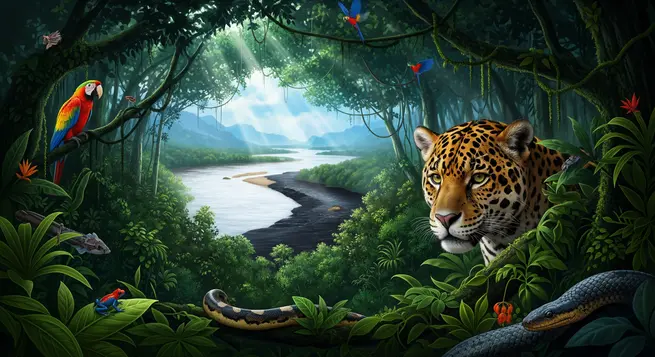

The Amazon Rainforest is one of the most vital ecosystems on earth. This quiz looks at its unique environment, rivers, and wildlife.
You will see questions about its rich biodiversity, indigenous cultures, and environmental changes. Some questions are straightforward, while others ask you to remember small details about soil and geography.
When you finish, try visiting our guides on natural wonders, explore majestic mountain ranges, or browse our other geographic spots.
On which continent is the Amazon Rainforest primarily located?
South America
South America
Asia
Asia
North America
North America
Africa
Africa
Which of these rivers is the largest tributary of the Amazon River?
Paraná
Paraná
Orinoco
Orinoco
São Francisco
São Francisco
Madeira
Madeira
What primary biome classification is used for the Amazon region?
Temperate grassland
Temperate grassland
Boreal forest
Boreal forest
Tropical rainforest
Tropical rainforest
Deciduous forest
Deciduous forest
The Amazon acts as a carbon sink by absorbing which gas from the atmosphere?
Carbon dioxide
Carbon dioxide
Oxygen
Oxygen
Methane
Methane
Nitrogen
Nitrogen
Which country contains approximately 60% of the total Amazon Rainforest?
Colombia
Colombia
Peru
Peru
Brazil
Brazil
Venezuela
Venezuela
What is widely cited as the leading driver of deforestation in the Brazilian Amazon?
Logging for timber
Logging for timber
Gold mining
Gold mining
Cattle ranching
Cattle ranching
Urban expansion
Urban expansion
What is the world’s largest species of rodent, commonly found in Amazonian wetlands?
An anaconda
An anaconda
An electric eel
An electric eel
A caiman
A caiman
A capybara
A capybara
In which mountain range does the Amazon River officially originate?
Appalachian Mountains
Appalachian Mountains
Brazilian Highlands
Brazilian Highlands
Andes Mountains
Andes Mountains
Guiana Highlands
Guiana Highlands
The Amazon is estimated to house approximately what percentage of the world’s known land-based biodiversity?
15%
15%
10%
10%
20%
20%
25%
25%
Which major city is situated at the confluence of the Rio Negro and the Solimões River, forming the Amazon proper?
Iquitos, Peru
Iquitos, Peru
Belém, Brazil
Belém, Brazil
Manaus, Brazil
Manaus, Brazil
Pucallpa, Peru
Pucallpa, Peru
What natural resource led to a massive economic boom in the Amazon during the late 19th century?
Cacao trees
Cacao trees
Brazil nut trees
Brazil nut trees
Acai palms
Acai palms
Rubber trees
Rubber trees
Which large, semi-nomadic indigenous group inhabits the border region between Brazil and Venezuela?
The Ticuna
The Ticuna
The Kayapó
The Kayapó
The Yawanawá
The Yawanawá
The Yanomami
The Yanomami
Why is the “white water” of the Amazon River distinct from “black water” tributaries?
It contains no aquatic life
It contains no aquatic life
It is fully saline
It is fully saline
It has high sediment content
It has high sediment content
It is entirely static
It is entirely static
What is the estimated proportion of all known species on Earth found in the Amazon?
One-eighth
One-eighth
One-twelfth
One-twelfth
One-tenth
One-tenth
One-fifteenth
One-fifteenth
Which group of organisms accounts for the highest number of identified species in the Amazon?
Mammals
Mammals
Insects
Insects
Amphibians
Amphibians
Plants
Plants
In what year did the Brazilian government implement the major action plan (PPCDAM) that significantly reduced deforestation rates for nearly a decade?
2004
2004
2002
2002
2000
2000
2006
2006
What is the largest feline species found in the Amazon ecosystem?
Cougar
Cougar
Margay
Margay
Jaguar
Jaguar
Ocelot
Ocelot
What is the name of the nutrient-rich, man-made dark soil found in parts of the Amazon that indicates ancient indigenous agriculture?
Laterite soil
Laterite soil
Peat soil
Peat soil
Terra preta
Terra preta
Alluvial silt
Alluvial silt
Into which body of water does the Amazon River discharge its massive volume of water?
Gulf of Mexico
Gulf of Mexico
Atlantic Ocean
Atlantic Ocean
Pacific Ocean
Pacific Ocean
Caribbean Sea
Caribbean Sea
To which language family does Nheengatu, the historical lingua franca of the Amazon region, belong?
Arawakan
Arawakan
Panoan
Panoan
Quechuan
Quechuan
Tupian
Tupian
According to the World Wildlife Fund (WWF), approximately how many indigenous people are estimated to live in the Amazon region today?
1.7 million
1.7 million
2.7 million
2.7 million
2.2 million
2.2 million
3.2 million
3.2 million
What is the approximate length of the Amazon River in kilometers?
7,000 km
7,000 km
6,400 km
6,400 km
5,800 km
5,800 km
7,600 km
7,600 km
You can do better
Not bad
Great!
If you enjoyed this, check out our trivia on travel curiosities, learn about famous cities, or search through iconic landmarks.