

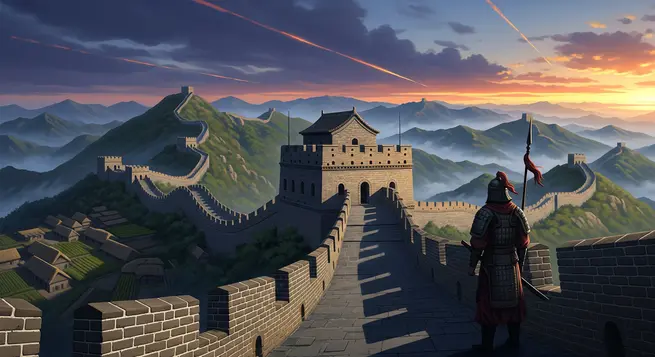
The Great Wall of China is one of the most famous ancient structures on Earth, yet several myths and misconceptions still surround its history.
This quiz looks at the engineering behind the wall, the different dynasties that built it, and the unique, proven materials used to hold it together over the centuries.
Once you finish, check out our selection of trivia on historic places, explore UNESCO architecture, or see what you know about other famous landmarks.
What is the common, yet scientifically inaccurate, myth regarding the Great Wall of China?
It is visible to the naked eye from the Moon.
It is visible to the naked eye from the Moon.
It is only visible at night due to artificial lighting.
It is only visible at night due to artificial lighting.
It is only visible during specific seasons.
It is only visible during specific seasons.
It is visible to the naked eye from Mars.
It is visible to the naked eye from Mars.
Which architectural feature was commonly used throughout the wall to provide defensive positions and signal platforms?
Stone foundations
Stone foundations
Watchtowers
Watchtowers
Moats
Moats
Drawbridges
Drawbridges
Which dynasty was responsible for building the vast majority of the brick and stone structures seen today?
Tang dynasty
Tang dynasty
Song dynasty
Song dynasty
Ming dynasty
Ming dynasty
Han dynasty
Han dynasty
Which dynasty is historically famous for initiating the first major project to join disparate defensive walls into a unified northern boundary?
The Qin Dynasty
The Qin Dynasty
The Zhou Dynasty
The Zhou Dynasty
The Qing Dynasty
The Qing Dynasty
The Tang Dynasty
The Tang Dynasty
According to the official study conducted by China’s State Administration of Cultural Heritage in 2012, what is the total length of the Great Wall including all its branches?
19,196 kilometers
19,196 kilometers
20,196 kilometers
20,196 kilometers
22,196 kilometers
22,196 kilometers
21,196 kilometers
21,196 kilometers
What was the primary defensive purpose of the construction of the Great Wall?
To create an international trade route.
To create an international trade route.
To protect against northern nomadic incursions.
To protect against northern nomadic incursions.
To mark the boundaries of ancient provinces.
To mark the boundaries of ancient provinces.
To prevent flooding from rivers.
To prevent flooding from rivers.
Which unique, scientifically proven material was used during the Ming dynasty construction to bind bricks together?
Glutinous rice mortar
Glutinous rice mortar
Wooden beams
Wooden beams
Clay tiles
Clay tiles
Granite bricks
Granite bricks
What was the most common material used to construct the earliest sections of the wall?
Reinforced concrete
Reinforced concrete
Marble blocks
Marble blocks
Rammed earth
Rammed earth
Steel supports
Steel supports
How did guards at the watchtowers communicate messages of impending danger across long distances?
Broadcasting loud noises.
Broadcasting loud noises.
Sending runner scouts.
Sending runner scouts.
Relying on carrier pigeons.
Relying on carrier pigeons.
Sending smoke signals by day and fire by night.
Sending smoke signals by day and fire by night.
Which of the following best describes the structural layout of the Great Wall?
It is a single, continuous, unbroken wall.
It is a single, continuous, unbroken wall.
It is a series of overlapping walls and natural barriers like mountains and rivers.
It is a series of overlapping walls and natural barriers like mountains and rivers.
It follows a perfectly straight line.
It follows a perfectly straight line.
It consists only of man-made structures.
It consists only of man-made structures.
Which nomadic group was the primary motivation for the Qin Dynasty to consolidate early defensive walls?
The Jurchen people
The Jurchen people
The Persians
The Persians
The Xiongnu
The Xiongnu
The Mongols
The Mongols
What was the approximate average width of the top of the wall during the Ming dynasty, serving as a tactical advantage for troops?
6 to 7 meters
6 to 7 meters
4 to 5 meters
4 to 5 meters
2 to 3 meters
2 to 3 meters
8 to 9 meters
8 to 9 meters
Which ruler famously unified China and began the connection of existing defensive walls?
Emperor Yongle
Emperor Yongle
Emperor Taizong of Tang
Emperor Taizong of Tang
Emperor Wu of Han
Emperor Wu of Han
Emperor Qin Shi Huang
Emperor Qin Shi Huang
Aside from defense, what was the primary function of the agricultural settlements established along the wall?
To act as centralized tax-collection hubs for domestic trade
To act as centralized tax-collection hubs for domestic trade
To harvest timber for building imperial palaces
To harvest timber for building imperial palaces
To serve as diplomatic meeting points for foreign envoys
To serve as diplomatic meeting points for foreign envoys
To produce food for stationed soldiers to achieve self-sufficiency
To produce food for stationed soldiers to achieve self-sufficiency
What international designation officially covers the protection and preservation of the Great Wall of China?
Ramsar Wetland of International Importance
Ramsar Wetland of International Importance
UNESCO Biosphere Reserve
UNESCO Biosphere Reserve
IUCN Protected Area
IUCN Protected Area
UNESCO World Heritage Site
UNESCO World Heritage Site
Approximately how long did the total construction process span, from the earliest walls to the completion of the final Ming sections?
2,000 years
2,000 years
2,500 years
2,500 years
1,500 years
1,500 years
3,000 years
3,000 years
What is the state of the earliest sections of the wall constructed during the Qin dynasty?
They were completely destroyed by modern industrial development.
They were completely destroyed by modern industrial development.
Much of the early earthen sections have eroded or disappeared due to wind and time.
Much of the early earthen sections have eroded or disappeared due to wind and time.
Most sections remain fully intact and are popular tourist destinations.
Most sections remain fully intact and are popular tourist destinations.
They were systematically dismantled by subsequent dynasties for building materials.
They were systematically dismantled by subsequent dynasties for building materials.
Beyond military defense, how did the Great Wall serve an administrative purpose?
It acted as a primary distribution center for national grain reserves.
It acted as a primary distribution center for national grain reserves.
It functioned as a sophisticated border control system regulating trade and migration as well.
It functioned as a sophisticated border control system regulating trade and migration as well.
It served as a central hub for training imperial civil servants.
It served as a central hub for training imperial civil servants.
It was used as a prison network for political dissidents.
It was used as a prison network for political dissidents.
Large portions of the wall, particularly in northern regions, were built to navigate and monitor which major geographic obstacle?
The Pamir Mountains
The Pamir Mountains
The Taklamakan Desert
The Taklamakan Desert
The Gobi Desert
The Gobi Desert
The Tibetan Plateau
The Tibetan Plateau
Which social groups were primarily responsible for the arduous construction of the Great Wall?
It was built entirely by volunteer civilian labor.
It was built entirely by volunteer civilian labor.
It relied exclusively on guilds of paid professional stonemasons.
It relied exclusively on guilds of paid professional stonemasons.
It utilized the labor of soldiers, peasants, and convicts.
It utilized the labor of soldiers, peasants, and convicts.
It was constructed solely by foreign prisoners of war.
It was constructed solely by foreign prisoners of war.
What is an important historical context regarding the success of the Great Wall’s defensive capability?
Success in defending the wall often depended on the strength of the army stationed there, not just the stone.
Success in defending the wall often depended on the strength of the army stationed there, not just the stone.
It was effectively impenetrable, preventing all invasions.
It was effectively impenetrable, preventing all invasions.
It was built entirely in one single century.
It was built entirely in one single century.
It was only intended to stop animals.
It was only intended to stop animals.
Which structure is famously known as the ‘First Pass of the Great Wall’ where the wall meets the sea?
The Juyongguan Pass.
The Juyongguan Pass.
The Badaling section.
The Badaling section.
The Jiayuguan Pass.
The Jiayuguan Pass.
The Shanhaiguan Pass.
The Shanhaiguan Pass.
You can do better
Not bad
Great!
If you enjoyed this, try our quizzes on architecture, learn about mountains and landscapes, or discover some odd travel curiosities next.