

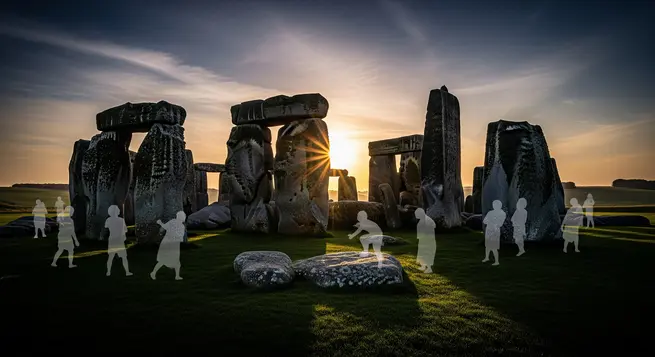

Stonehenge remains one of the most debated ancient monuments on the planet. Built over thousands of years, this Neolithic marvel in Wiltshire, England, continues to puzzle researchers and draw millions of visitors.
This quiz looks at the construction phases, the origins of the massive stones, and the celestial alignments of the site. You will see questions about archaeological findings and the old theories that shaped our understanding of the megaliths.
Once you finish, you can browse other historic places, discover beautiful UNESCO architecture, or see how well you know other famous landmarks.
In which English county is the prehistoric monument of Stonehenge located?
Kent
Kent
Somerset
Somerset
Cornwall
Cornwall
Wiltshire
Wiltshire
The massive sarsen stones that form the outer circle and inner trilithons are a type of which rock?
Limestone
Limestone
Granite
Granite
Sandstone
Sandstone
Marble
Marble
Stonehenge was constructed in multiple phases, with the erection of the major sarsen stone circle dating back to which archaeological period?
Iron Age
Iron Age
Bronze Age
Bronze Age
Medieval Period
Medieval Period
Neolithic
Neolithic
Archaeological evidence suggests that the earliest phase of Stonehenge, consisting of a circular ditch and bank, dates to approximately which time period?
2500 BC
2500 BC
3000 BC
3000 BC
2000 BC
2000 BC
3500 BC
3500 BC
The main axis of Stonehenge is aligned with the sunrise of which significant annual event?
The Spring Equinox
The Spring Equinox
The Autumn Equinox
The Autumn Equinox
The Winter Solstice
The Winter Solstice
The Summer Solstice
The Summer Solstice
Modern scientific analysis indicates that the smaller ‘bluestones’ were transported to Stonehenge from which location?
Bodmin Moor
Bodmin Moor
The Mendip Hills
The Mendip Hills
Marlborough Downs
Marlborough Downs
The Preseli Hills in Wales
The Preseli Hills in Wales
While initial theories debated how bluestones reached the site, current consensus supports which method of transport?
Glacial drift
Glacial drift
Human transport by land and water
Human transport by land and water
Man-made earthworks only
Man-made earthworks only
Volcanic activity
Volcanic activity
What is the approximate average weight of the large sarsen stones used in the construction of the site?
25 tons
25 tons
15 tons
15 tons
20 tons
20 tons
30 tons
30 tons
Which of these is the most widely supported archaeological theory regarding the primary purpose of Stonehenge?
A fortress
A fortress
A royal residence
A royal residence
An observatory or ritual site
An observatory or ritual site
A marketplace
A marketplace
The upright sarsens were connected to the horizontal lintels using what construction technique?
Dovetail joints
Dovetail joints
Cement mortar
Cement mortar
Iron nails
Iron nails
Mortise and tenon joints
Mortise and tenon joints
In which century was the first full-scale restoration of Stonehenge undertaken to stabilize leaning stones?
19th century
19th century
20th century
20th century
18th century
18th century
21st century
21st century
What is the name given to the series of 56 chalk-filled pits found inside the inner edge of the ditch at Stonehenge?
The Altar Stone
The Altar Stone
The Heel Stone
The Heel Stone
The Slaughter Stone
The Slaughter Stone
Aubrey Holes
Aubrey Holes
Approximately how far, as the crow flies, were the bluestones transported from their origin points in Wales to reach Stonehenge?
100 miles
100 miles
200 miles
200 miles
250 miles
250 miles
150 miles
150 miles
Who was the astronomer that famously published a book in the 1960s arguing that Stonehenge functioned as a sophisticated cosmic computer?
Gerald Hawkins
Gerald Hawkins
Inigo Jones
Inigo Jones
William Stukeley
William Stukeley
John Aubrey
John Aubrey
Which isolated stone stands outside the main circle and aligns with the sunrise on the summer solstice?
The Station Stone
The Station Stone
The Heel Stone
The Heel Stone
The Slaughter Stone
The Slaughter Stone
The Altar Stone
The Altar Stone
Excavations in the early 20th century revealed the existence of a ‘Woodhenge’ nearby, suggesting the landscape also featured what kind of monuments?
Wood circles
Wood circles
Copper circles
Copper circles
Iron circles
Iron circles
Bronze circles
Bronze circles
Excavations inside the Aubrey Holes at Stonehenge have yielded what significant discovery regarding human activity?
No human remains found
No human remains found
Cremation remains
Cremation remains
Full skeletons
Full skeletons
Animal remains only
Animal remains only
Archaeologists found a large Neolithic settlement nearby that is now believed to have housed the people who built Stonehenge, known as:
Dholavira
Dholavira
Maiden Castle
Maiden Castle
Durrington Walls
Durrington Walls
Silbury Hill
Silbury Hill
In 1986, Stonehenge was designated what status by the United Nations?
European Protected Landmark
European Protected Landmark
Ancient Monument of Global Significance
Ancient Monument of Global Significance
UNESCO World Heritage Site
UNESCO World Heritage Site
National Treasure of England
National Treasure of England
Before the permanent stone structures were finalized, what material was used in the earlier phases of the monument?
Limestone slabs
Limestone slabs
Animal bones
Animal bones
Large wooden posts
Large wooden posts
Sandstone blocks
Sandstone blocks
Recent studies suggest that Stonehenge’s construction might also have been influenced by which complex celestial event?
Equinox sunrise
Equinox sunrise
Winter Solstice sunset
Winter Solstice sunset
Summer Solstice sunset
Summer Solstice sunset
Lunar Standstill cycle
Lunar Standstill cycle
Estimates suggest that building the various phases of Stonehenge required thousands of man-hours, totaling roughly how many workers over many generations?
5,000 workers
5,000 workers
10,000 workers
10,000 workers
2,000 workers
2,000 workers
20,000 workers
20,000 workers
You can do better
Not bad
Great!
If you liked this, try our quizzes on sacred architecture. We also have general quizzes on places and unique travel curiosities.