

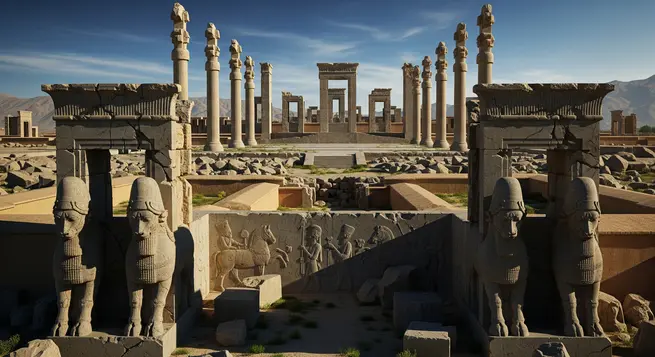
Persepolis was the grand ceremonial capital of the Achaemenid Empire. Built over generations, its soaring stone columns and monumental gates stood as a testament to ancient Persian power before Alexander the Great burned it to the ground.
This quiz looks at the kings who built this ancient wonder, its remarkable design features, and the eventual downfall of the palace complex. You will see questions about its construction details, famous ruins, and archaeological discoveries.
Once you finish, check out our trivia on famous buildings, explore other historic places, or see our quizzes on UNESCO architecture.
In which modern-day country are the architectural ruins of Persepolis located?
Greece
Greece
Egypt
Egypt
Iran
Iran
Turkey
Turkey
Which Achaemenid king is credited with founding the construction of Persepolis?
Darius I
Darius I
Cyrus the Great
Cyrus the Great
Artaxerxes I
Artaxerxes I
Xerxes I
Xerxes I
What is the name of the grand audience hall in Persepolis known for its massive stone columns and intricate reliefs?
The Treasury
The Treasury
The Gate of All Nations
The Gate of All Nations
The Apadana Palace
The Apadana Palace
The Tachara
The Tachara
Which famous conqueror burned Persepolis to the ground in 330 BCE?
Alexander the Great
Alexander the Great
Hannibal Barca
Hannibal Barca
Genghis Khan
Genghis Khan
Julius Caesar
Julius Caesar
What primary building material was used for the majority of the monumental structures in Persepolis?
Marble
Marble
Limestone
Limestone
Granite
Granite
Sandstone
Sandstone
Which distinct feature is commonly found topping the massive columns in the Apadana Palace?
Bull-headed capitals
Bull-headed capitals
Doric columns
Doric columns
Caryatids
Caryatids
Corinthian capitals
Corinthian capitals
The reliefs on the Apadana staircase generally depict delegations bearing gifts, which scholars believe represents the celebration of:
Tax collection rituals
Tax collection rituals
Nowruz (Persian New Year)
Nowruz (Persian New Year)
Victory celebrations
Victory celebrations
Royal coronations
Royal coronations
Which king was responsible for completing the construction of the Apadana Palace?
Cambyses II
Cambyses II
Darius II
Darius II
Xerxes I
Xerxes I
Cyrus the Younger
Cyrus the Younger
Which structure at Persepolis served as the monumental entrance gate built by Xerxes I?
The Gate of All Nations
The Gate of All Nations
The Palace of Darius
The Palace of Darius
The Tripylon Hall
The Tripylon Hall
The Treasury of Persepolis
The Treasury of Persepolis
While the remains are now bare stone, archaeological evidence suggests many surfaces in Persepolis were originally finished with:
Polychrome tiles
Polychrome tiles
Lapis lazuli
Lapis lazuli
Gold inlay
Gold inlay
Painted plaster
Painted plaster
The Achaemenid style of architecture at Persepolis was a synthesis of styles brought by workers from across the empire, but who provided the primary artistic influence for the court dress shown in the reliefs?
Babylonian artisans
Babylonian artisans
Egyptians
Egyptians
Medes and Persians
Medes and Persians
Greek craftsmen
Greek craftsmen
Approximately how tall are the surviving columns of the Apadana Palace?
Fifteen meters
Fifteen meters
Twenty meters
Twenty meters
Thirty meters
Thirty meters
Twenty-five meters
Twenty-five meters
According to historical accounts by Plutarch, who persuaded Alexander to burn the palace during a night of heavy drinking?
Cleopatra VII
Cleopatra VII
Thais the Athenian courtesan
Thais the Athenian courtesan
Olympias of Epirus
Olympias of Epirus
Artemisia I
Artemisia I
Which smaller private palace, built by Xerxes I, sits at a higher elevation than the other structures?
Hadish
Hadish
Apadana
Apadana
Tripylon
Tripylon
Tachara
Tachara
What is the most widely cited motive for Alexander the Great’s destruction of the ceremonial complex?
Persian Empire collapse
Persian Empire collapse
Lack of maintenance funds
Lack of maintenance funds
An accidental kitchen fire
An accidental kitchen fire
Revenge for the Burning of Athens
Revenge for the Burning of Athens
Which archaeological discovery provided vital confirmation of the palace’s construction timeline and the extent of the Achaemenid Empire?
Foundation tablets of Darius I
Foundation tablets of Darius I
Alexander’s war diaries
Alexander’s war diaries
Persian oral tradition
Persian oral tradition
Medieval traveler logs
Medieval traveler logs
On what kind of massive foundation structure was the palace complex of Persepolis built?
A series of wooden pilings
A series of wooden pilings
A man-made stone platform
A man-made stone platform
A natural sand dune
A natural sand dune
A vaulted brick crypt
A vaulted brick crypt
The winged bull motifs found in Persepolis gateway designs show a clear artistic carry-over from which older civilization?
Assyrian influence
Assyrian influence
Central Asian nomadic style
Central Asian nomadic style
Hellenistic revival
Hellenistic revival
Urartian fortresses
Urartian fortresses
How many columns supported the roof of the great Apadana hall?
84 columns
84 columns
60 columns
60 columns
72 columns
72 columns
96 columns
96 columns
What set of administrative records found at the site provides details about the wages paid to workers during the construction?
The Behistun Inscription
The Behistun Inscription
The Cyrus Cylinder
The Cyrus Cylinder
The Treasury tablets
The Treasury tablets
The Babylonian Chronicle
The Babylonian Chronicle
Persepolis is situated at the foot of which mountain range?
Zagros mountain range
Zagros mountain range
Caucasus mountain range
Caucasus mountain range
Alborz mountain range
Alborz mountain range
Mardin mountain range
Mardin mountain range
How were the monumental columns of Persepolis structurally assembled?
They were composed of several drums joined by iron cramps and lead
They were composed of several drums joined by iron cramps and lead
They were cast from bronze alloys
They were cast from bronze alloys
They were made of a single continuous stone block
They were made of a single continuous stone block
They were hollow cylinders made of brick
They were hollow cylinders made of brick
You can do better
Not bad
Great!
If you enjoyed this, check out our quizzes on monumental palaces, find other famous landmarks, or learn about interesting architectural details around the world.