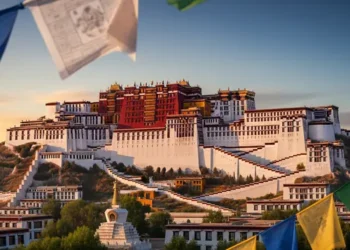


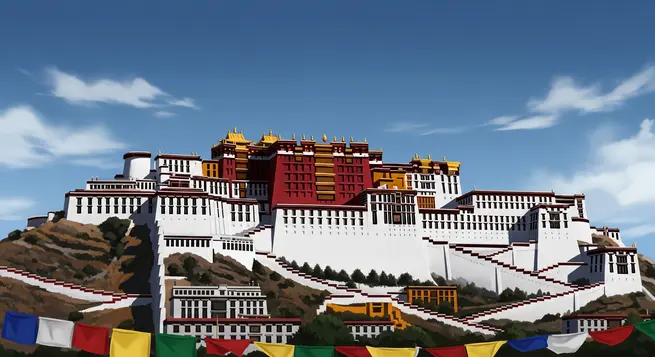

The Potala Palace stands as an iconic symbol of Tibetan history, towering high above the city of Lhasa. This legendary fortress-palace has housed leaders, preserved sacred relics, and witnessed centuries of cultural shifts.
This trivia challenge focuses on its unique design, key historical figures, and structural details. You will need to recall facts about its various halls, construction materials, and religious importance.
Once you finish, you can explore more about castles and palaces, read up on sacred architecture, or see how well you know other famous landmarks.
In which Tibetan city is the Potala Palace located?
Kathmandu
Kathmandu
Lhasa
Lhasa
Beijing
Beijing
Thimphu
Thimphu
Which part of the Potala Palace complex is primarily dedicated to prayer and religious study?
Red Palace
Red Palace
Green Palace
Green Palace
Blue Palace
Blue Palace
Golden Palace
Golden Palace
The Potala Palace is built upon a hill historically known as what?
Mount Nyainqentanglha
Mount Nyainqentanglha
Mount Kailash
Mount Kailash
Mount Everest
Mount Everest
Marpo Ri
Marpo Ri
Traditionally, the Potala Palace served as the residence for the Dalai Lamas during which season?
Autumn
Autumn
Summer
Summer
Spring
Spring
Winter
Winter
Approximately at what altitude is the Potala Palace situated?
3,700 meters above sea level
3,700 meters above sea level
2,700 meters above sea level
2,700 meters above sea level
4,200 meters above sea level
4,200 meters above sea level
3,200 meters above sea level
3,200 meters above sea level
What are the primary traditional building materials used in the construction of the Potala Palace?
Concrete and glass
Concrete and glass
Stone and wood
Stone and wood
Steel and marble
Steel and marble
Brick and iron
Brick and iron
During which century was the current, major structure of the Potala Palace expanded by the Fifth Dalai Lama?
15th century
15th century
16th century
16th century
18th century
18th century
17th century
17th century
Which color identifies the section of the palace complex used for administrative and residential purposes?
Gold
Gold
White
White
Black
Black
Yellow
Yellow
The Potala Palace was designated as what in 1994?
UNESCO World Heritage Site
UNESCO World Heritage Site
Seven Wonders of the World
Seven Wonders of the World
Imperial Temple complex
Imperial Temple complex
National Monument of China
National Monument of China
Which early Tibetan king is credited with building the original fortress on the site in the 7th century?
Gedun Drub
Gedun Drub
Thupten Gyatso
Thupten Gyatso
Tenzin Gyatso
Tenzin Gyatso
Songtsen Gampo
Songtsen Gampo
The name ‘Potala’ is derived from the mythical mountain home of which figure in Tibetan Buddhism?
Protector of the Dharma
Protector of the Dharma
Deity of Wealth
Deity of Wealth
Bodhisattva of Compassion
Bodhisattva of Compassion
Buddha of Infinite Light
Buddha of Infinite Light
What is the name of the traditional summer palace of the Dalai Lamas located in Lhasa?
Ramoche Temple
Ramoche Temple
Jokhang Temple
Jokhang Temple
Sera Monastery
Sera Monastery
Norbulingka
Norbulingka
What precious objects are housed within the Red Palace, marking the final resting places of various Dalai Lamas?
The extensive library of palm-leaf manuscripts
The extensive library of palm-leaf manuscripts
The collection of sacred tangkas
The collection of sacred tangkas
The golden stupas
The golden stupas
The massive bronze Buddha statues
The massive bronze Buddha statues
Many of the palace’s rooftops are covered in which material to give them their iconic luster?
Solid jade
Solid jade
Copper and gold leaf
Copper and gold leaf
Painted ceramic
Painted ceramic
Stained glass
Stained glass
Roughly how many rooms are contained within the Potala Palace?
1,500 rooms
1,500 rooms
1,000 rooms
1,000 rooms
1,200 rooms
1,200 rooms
800 rooms
800 rooms
The interior decorations and architectural layout are heavily influenced by what traditional religious geometric design?
Military fortification designs
Military fortification designs
Calligraphic inscriptions of mantras
Calligraphic inscriptions of mantras
Floral tapestries
Floral tapestries
Mandala motifs
Mandala motifs
Which Dalai Lama, known as the ‘Great Fifth’, initiated the construction of the palace as it is largely known today?
Lungtok Gyatso
Lungtok Gyatso
Tsangyang Gyatso
Tsangyang Gyatso
Lobsang Gyatso
Lobsang Gyatso
Kalsang Gyatso
Kalsang Gyatso
What form of art covering the interior walls is one of the most significant cultural treasures of the palace?
Elaborate exterior neon lighting
Elaborate exterior neon lighting
Wall paintings (murals)
Wall paintings (murals)
European-style oil portraits
European-style oil portraits
Mosaic tile floors
Mosaic tile floors
The inward-sloping (battered) walls of the palace were primarily designed for which structural purpose?
To create secret interior ventilation channels
To create secret interior ventilation channels
To reduce wind resistance at high altitudes
To reduce wind resistance at high altitudes
To prevent rainwater from pooling on the building exterior
To prevent rainwater from pooling on the building exterior
To prevent structural collapse during earthquakes
To prevent structural collapse during earthquakes
Historically, what function did the cells in the White Palace serve?
Living quarters for monks and government officials
Living quarters for monks and government officials
Grand throne room for the Dalai Lama
Grand throne room for the Dalai Lama
Sutra printing workshop
Sutra printing workshop
Public school classroom
Public school classroom
The ‘Chogyel Drupuk’ within the Potala is considered one of its most sacred sites, containing what?
A forest garden
A forest garden
A subterranean lake
A subterranean lake
An iron smelter
An iron smelter
A sacred cave
A sacred cave
What architectural feature allows light and air into the heart of the deeply-set palace structures?
A central tower taller than all others
A central tower taller than all others
A complex network of ventilation shafts
A complex network of ventilation shafts
A system of secret tunnels for escape
A system of secret tunnels for escape
A series of large terraced courtyards
A series of large terraced courtyards
You can do better
Not bad
Great!
For more like this, try our quiz on UNESCO architecture. We also feature trivia on historic places and classic famous buildings.