

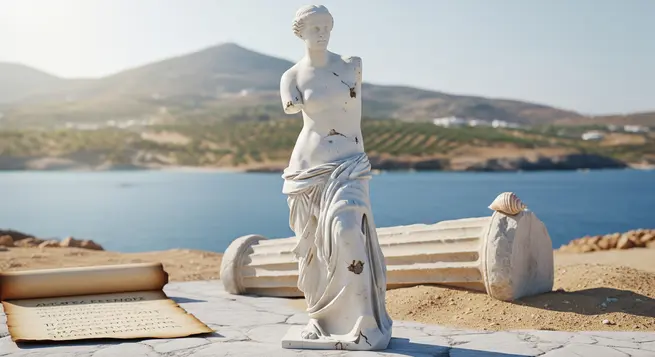
The Venus de Milo stands as one of the most famous archaeological finds in history. Discovered on a Greek island in 1820, this classical masterpiece has sparked centuries of debate regarding its origins, missing arms, and true identity.
This quiz looks at the details of its excavation, the peasant who uncovered it, and its home in Paris. You will see questions about its artistic style, materials, and the myths surrounding its missing limbs.
After you finish, check out our trivia on famous sculptures, explore other celebrated art masterpieces, or learn about the world’s great museums and galleries.
Milos, the place where the famous sculpture was discovered, is best described as what?
A district in ancient Athens
A district in ancient Athens
A port city in Asia Minor
A port city in Asia Minor
A mountain in central Greece
A mountain in central Greece
A Greek island in the Aegean Sea
A Greek island in the Aegean Sea
The Venus de Milo is an iconic masterpiece typically studied in which academic discipline?
Art History
Art History
Astronomy
Astronomy
Mythology
Mythology
Philosophy
Philosophy
In which world-famous museum is the Venus de Milo currently housed?
The Louvre Museum
The Louvre Museum
The British Museum
The British Museum
The Metropolitan Museum of Art
The Metropolitan Museum of Art
The Uffizi Gallery
The Uffizi Gallery
In which century was the Venus de Milo discovered?
18th century
18th century
17th century
17th century
19th century
19th century
20th century
20th century
The Venus de Milo was sculpted primarily out of which material?
Bronze
Bronze
Limestone
Limestone
Marble
Marble
Terracotta
Terracotta
According to historical accounts, who is credited with the initial discovery of the sculpture on Milos?
A naval officer
A naval officer
A local schoolteacher
A local schoolteacher
A farmer
A farmer
A professional archaeologist
A professional archaeologist
Art historians classify the style and origins of the Venus de Milo as belonging to which era?
Hellenistic period
Hellenistic period
Archaic period
Archaic period
Byzantine period
Byzantine period
Classical period
Classical period
The figure portrayed in the sculpture is widely believed to represent which goddess?
Aphrodite
Aphrodite
Athena
Athena
Hera
Hera
Artemis
Artemis
One prevalent theory suggests the sculpture sustained damage to its arms during which event?
Intentionally broken upon discovery
Intentionally broken upon discovery
Natural erosion over centuries
Natural erosion over centuries
Damage during a local conflict
Damage during a local conflict
A shipwreck during transport
A shipwreck during transport
At the time of its 1820 discovery, the island of Milos was under the sovereignty of which power?
The Ottoman Empire
The Ottoman Empire
The French Empire
The French Empire
The Kingdom of Greece
The Kingdom of Greece
The Russian Empire
The Russian Empire
Which object, found in a marble hand near the statue during its excavation, led to the hypothesis that the Venus de Milo originally held it?
A mirror
A mirror
An apple
An apple
A lyre
A lyre
A shield
A shield
The Louvre Museum, which displays the Venus de Milo, is located in which city?
Berlin, Germany
Berlin, Germany
London, United Kingdom
London, United Kingdom
Rome, Italy
Rome, Italy
Paris, France
Paris, France
What was the name of the peasant who found the statue while digging on his land?
Arthur Evans
Arthur Evans
Lord Elgin
Lord Elgin
Heinrich Schliemann
Heinrich Schliemann
Yorgos Kentrotas
Yorgos Kentrotas
The Venus de Milo is a celebrated example of sculpture produced in which ancient civilization?
Ancient Rome
Ancient Rome
Ancient Greece
Ancient Greece
Ancient Egypt
Ancient Egypt
Ancient Persia
Ancient Persia
The inscription on the now-lost base of the Venus de Milo attributed the sculpture to Alexandros, an artist from which ancient city?
Athens
Athens
Alexandria
Alexandria
Pergamon
Pergamon
Antioch
Antioch
Which Greek sea goddess, the wife of Poseidon, is a major alternative identity proposed for the Venus de Milo?
Hestia, goddess of the hearth
Hestia, goddess of the hearth
Amphitrite, a sea goddess
Amphitrite, a sea goddess
Athena, goddess of wisdom
Athena, goddess of wisdom
Persephone, goddess of the underworld
Persephone, goddess of the underworld
According to a famous myth surrounding the Venus de Milo, how were its arms lost?
In a fire at the museum where it was first stored
In a fire at the museum where it was first stored
In a scuffle between French and Turkish sailors on a beach
In a scuffle between French and Turkish sailors on a beach
By a clumsy tourist during its first public exhibition
By a clumsy tourist during its first public exhibition
During a rough sea storm on the way to France
During a rough sea storm on the way to France
Which French diplomat was influential in acquiring the statue for France?
The Marquis de La Fayette
The Marquis de La Fayette
Napoleon Bonaparte
Napoleon Bonaparte
Louis XVIII
Louis XVIII
Charles de Marcellus
Charles de Marcellus
Which famous Roman-era sculpture of the goddess Venus (Aphrodite) is often compared to the Venus de Milo for its classical stylistic traits?
The Capitoline Venus
The Capitoline Venus
The Laocoön Group
The Laocoön Group
The Discobolus
The Discobolus
The Spinario
The Spinario
In what year was the Venus de Milo officially presented to King Louis XVIII?
1825
1825
1819
1819
1821
1821
1823
1823
Why is the Hellenistic style of the Venus de Milo considered significant in art history?
It represents the peak of symmetrical portraiture
It represents the peak of symmetrical portraiture
It marks the invention of the marble drill
It marks the invention of the marble drill
It reflects a shift from idealism to realism
It reflects a shift from idealism to realism
It is the only statue from this era made of Parian marble
It is the only statue from this era made of Parian marble
Which of the following is true regarding the conservation of the Venus de Milo at the Louvre?
It has never been documented as having been cleaned
It has never been documented as having been cleaned
It was restored once in the 19th century with bronze arms
It was restored once in the 19th century with bronze arms
It has undergone various minor repairs and cleaning processes
It has undergone various minor repairs and cleaning processes
It has suffered zero restoration since 1820
It has suffered zero restoration since 1820
You can do better
Not bad
Great!
If you liked this, try exploring the Aegean islands and beaches where the statue was found. We also have quizzes on symbols in art and other historic places.