

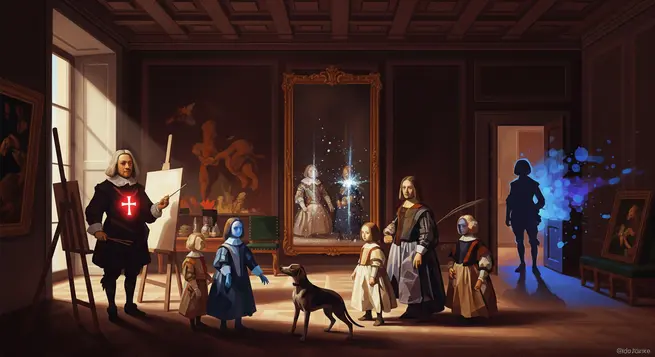
Diego Velazquez’s Las Meninas remains one of the most studied and mysterious paintings in Western art. This quiz explores the intricate details, historical context, and optical illusions hidden within the Spanish masterpiece.
You will see questions about the figures in the room, the meaning of the mirror reflection, and the artist’s own inclusion in the scene. Some look at straightforward details while others explore deeper compositional tricks.
Once you finish, check out our other quizzes on celebrated masterpieces, learn about famous artists throughout history, or browse our main art trivia section.
In what year did Diego Velázquez complete his masterpiece, Las Meninas?
1653
1653
1650
1650
1656
1656
1659
1659
Which city is home to the Museo del Prado, where Las Meninas is currently housed?
Paris
Paris
Madrid
Madrid
Rome
Rome
London
London
Who is the central young figure standing in the middle of the composition of Las Meninas?
The court dwarf Mari Bárbola
The court dwarf Mari Bárbola
King Philip IV
King Philip IV
Infanta Margaret Theresa
Infanta Margaret Theresa
Queen Mariana
Queen Mariana
What is famously located on the back wall in the center of the room in Las Meninas?
A mirror reflecting the king and queen
A mirror reflecting the king and queen
A window looking out onto the courtyard
A window looking out onto the courtyard
A painting inside a painting
A painting inside a painting
A tapestry depicting a mythological scene
A tapestry depicting a mythological scene
Which monarchs are traditionally identified as the figures reflected in the mirror of Las Meninas?
Charles II and his wife, Marie Louise of Orleans
Charles II and his wife, Marie Louise of Orleans
Philip IV and Mariana of Austria
Philip IV and Mariana of Austria
Philip III and Margaret of Austria
Philip III and Margaret of Austria
Ferdinand and Isabella
Ferdinand and Isabella
Why did Velázquez paint himself into the composition of Las Meninas?
To protest his low salary as a court painter.
To protest his low salary as a court painter.
To argue for the intellectual, rather than manual, nobility of painting.
To argue for the intellectual, rather than manual, nobility of painting.
To fulfill a guild regulation that required a self-portrait on all royal commissions.
To fulfill a guild regulation that required a self-portrait on all royal commissions.
To declare himself the next in line to the Spanish throne.
To declare himself the next in line to the Spanish throne.
Which knightly order’s red cross is depicted on Velázquez’s chest in Las Meninas?
Order of Santiago
Order of Santiago
Order of Montesa
Order of Montesa
Order of Calatrava
Order of Calatrava
Order of Alcántara
Order of Alcántara
According to the reflection in the background mirror, who is Velázquez implied to be painting on the large canvas?
The king and queen
The king and queen
The Infanta Margarita
The Infanta Margarita
The court dwarfs
The court dwarfs
The ladies-in-waiting
The ladies-in-waiting
Which of these actions is performed by one of the meninas (maids of honor) in the painting?
Offering a drink to the Infanta Margarita
Offering a drink to the Infanta Margarita
Holding a palette and paintbrush
Holding a palette and paintbrush
Standing in the open doorway
Standing in the open doorway
Nudging a dog with a foot
Nudging a dog with a foot
Which figure is shown standing in the open doorway in the background of Las Meninas?
Juan de Pareja
Juan de Pareja
Francisco de Zurbarán
Francisco de Zurbarán
José Nieto
José Nieto
Bartolomé Esteban Murillo
Bartolomé Esteban Murillo
What is the medium and support used for the painting Las Meninas?
Oil on wood panel
Oil on wood panel
Oil on canvas
Oil on canvas
Tempera on wood panel
Tempera on wood panel
Fresco on stone wall
Fresco on stone wall
Which philosopher wrote an influential analysis of Las Meninas in his book ‘The Order of Things’?
Francisco Goya
Francisco Goya
Pablo Picasso
Pablo Picasso
Salvador Dalí
Salvador Dalí
Michel Foucault
Michel Foucault
How does the composition of Las Meninas involve the viewer?
The scale of the figures implies they are all children.
The scale of the figures implies they are all children.
The perspective of the viewer mimics the position of the reflected king and queen.
The perspective of the viewer mimics the position of the reflected king and queen.
The canvas is painted from a perspective looking down from the ceiling.
The canvas is painted from a perspective looking down from the ceiling.
The lighting suggests that the room has no windows, only artificial light.
The lighting suggests that the room has no windows, only artificial light.
What historical detail adds intrigue to the red cross on Velázquez’s chest in the painting?
The cross was painted by King Philip IV himself.
The cross was painted by King Philip IV himself.
The cross was painted by a student of Velázquez after he died.
The cross was painted by a student of Velázquez after he died.
The Order of Santiago was awarded to Velázquez years after he completed the painting.
The Order of Santiago was awarded to Velázquez years after he completed the painting.
The painting original had a different portrait, which was painted over.
The painting original had a different portrait, which was painted over.
In which royal location does the scene of Las Meninas take place?
The Escorial Monastery
The Escorial Monastery
The Royal Palace of Aranjuez
The Royal Palace of Aranjuez
The Alcázar of Madrid
The Alcázar of Madrid
The Buen Retiro Palace
The Buen Retiro Palace
Which earlier masterpiece, known for its use of a mirror as a compositional device, is often compared to Las Meninas?
Jan van Eyck’s Arnolfini Portrait
Jan van Eyck’s Arnolfini Portrait
Caravaggio’s Calling of Saint Matthew
Caravaggio’s Calling of Saint Matthew
Leonardo da Vinci’s Last Supper
Leonardo da Vinci’s Last Supper
Raphael’s School of Athens
Raphael’s School of Athens
Which animal is depicted lying in the lower right corner of the painting?
Dog
Dog
Horse
Horse
Monkey
Monkey
Cat
Cat
What is the purpose of the high, dark ceiling depicted in the painting?
To show the vastness of the room and depth by keeping the canvas mostly dark.
To show the vastness of the room and depth by keeping the canvas mostly dark.
To emphasize the importance of the Infanta.
To emphasize the importance of the Infanta.
To create a mysterious atmosphere for the viewer.
To create a mysterious atmosphere for the viewer.
To draw attention to the mirror in the back.
To draw attention to the mirror in the back.
What is the optical paradox created by the mirror in Las Meninas?
The mirror shows a room entirely different from the one the Infanta is in.
The mirror shows a room entirely different from the one the Infanta is in.
The mirror reflection is actually a painting within a painting.
The mirror reflection is actually a painting within a painting.
The mirror reflects the king and queen, but they are technically supposed to be standing where the viewer is.
The mirror reflects the king and queen, but they are technically supposed to be standing where the viewer is.
The mirror is empty, suggesting the king and queen have already left.
The mirror is empty, suggesting the king and queen have already left.
Which artist created a famous series of 58 paintings in 1957 based on this masterpiece?
Pablo Picasso
Pablo Picasso
Henri Matisse
Henri Matisse
Joan Miró
Joan Miró
Salvador Dalí
Salvador Dalí
How did Velázquez achieve the complex sense of depth in Las Meninas?
He used a flat, two-dimensional style to emphasize the surface of the canvas.
He used a flat, two-dimensional style to emphasize the surface of the canvas.
He painted the figures with distorted proportions to emphasize their status.
He painted the figures with distorted proportions to emphasize their status.
He used bright, contrasting colors to make the room seem smaller.
He used bright, contrasting colors to make the room seem smaller.
He used perspective to create a sense of space that extends beyond the picture plane.
He used perspective to create a sense of space that extends beyond the picture plane.
Why is Las Meninas considered one of the most intellectually analyzed paintings in Western art history?
The secret messages encoded in the brushstrokes.
The secret messages encoded in the brushstrokes.
The study of the relationship between the observer, the observed, and the act of looking.
The study of the relationship between the observer, the observed, and the act of looking.
The use of gold leaf to highlight royal figures.
The use of gold leaf to highlight royal figures.
The hidden symbolism related to the Spanish Inquisition.
The hidden symbolism related to the Spanish Inquisition.
You can do better
Not bad
Great!
If you enjoy this quiz, try exploring symbols in art. You can also read about grand castles and palaces or test your memory on museums and galleries.