

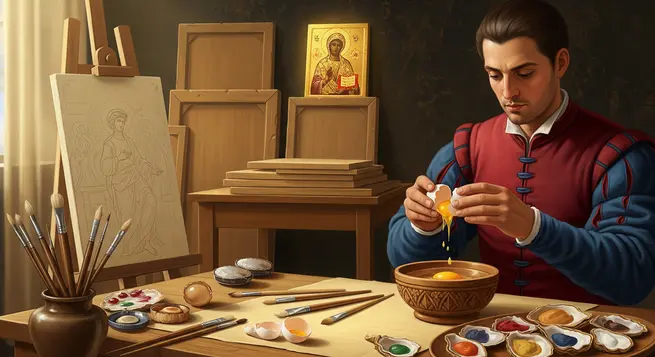
Tempera was the go-to medium for master painters before oil paints took over. This classic technique relies on a simple mix of egg yolk and dry pigment to create luminous, long-lasting art.
This quiz looks at the unique chemistry of egg tempera, its historical timeline, and the famous artists who mastered it. You will see questions about panel preparation, drying times, and Renaissance masterpieces.
Once you finish, why not explore our other challenges? Check out our pages on painting techniques, study famous artists, or test your memory on masterpieces of the art world.
Which part of the egg is traditionally used as the binder in egg tempera painting?
White
White
Shell
Shell
Yolk
Yolk
Chalaza
Chalaza
Because tempera paint is brittle, what surface was the traditional support used for painting it?
Metal leaf sheets
Metal leaf sheets
Gessoed rigid wood panel
Gessoed rigid wood panel
Plywood
Plywood
Canvas on stretchers
Canvas on stretchers
What is a primary characteristic of the way tempera paint handles during the painting process?
It dries very quickly
It dries very quickly
It dries slowly, allowing for blending
It dries slowly, allowing for blending
It is highly toxic to the touch
It is highly toxic to the touch
It can be layered like watercolors indefinitely
It can be layered like watercolors indefinitely
Which historical art tradition is famous for its extensive use of egg tempera on wood panels, often featuring gold backgrounds?
Byzantine religious icons
Byzantine religious icons
Abstract Expressionist murals
Abstract Expressionist murals
Dutch Golden Age portraits
Dutch Golden Age portraits
Impressionist landscapes
Impressionist landscapes
What is the traditional ingredient often added to the wood panel before painting to create a smooth, absorbent base for tempera?
Walnut oil
Walnut oil
Rabbit skin glue
Rabbit skin glue
Linseed oil
Linseed oil
Beeswax
Beeswax
Which Renaissance master is renowned for using tempera to create large-scale mythological works like ‘The Birth of Venus’?
Raphael
Raphael
Leonardo da Vinci
Leonardo da Vinci
Michelangelo
Michelangelo
Sandro Botticelli
Sandro Botticelli
During which century did oil painting largely replace tempera in Western European art due to its ability to create smooth transitions and depth?
16th century
16th century
15th century
15th century
14th century
14th century
17th century
17th century
Since tempera dries too fast to blend on the surface, what technique do artists use to create value and color transitions?
Glazing
Glazing
Impasto
Impasto
Wet-on-wet blending
Wet-on-wet blending
Hatching and cross-hatching
Hatching and cross-hatching
What is a major visual difference between a finished tempera painting and a traditional oil painting?
It is extremely flexible and highly resistant to cracking
It is extremely flexible and highly resistant to cracking
It has deeper and more saturated colors
It has deeper and more saturated colors
It allows for much thicker and more textured brushstrokes
It allows for much thicker and more textured brushstrokes
It has a distinct matte finish rather than a glossy surface
It has a distinct matte finish rather than a glossy surface
What is often added to the egg yolk medium in small amounts to prevent the paint from rotting and to adjust its consistency?
Vinegar or wine
Vinegar or wine
Egg white
Egg white
Extra virgin olive oil
Extra virgin olive oil
Distilled water
Distilled water
In which Italian city did Sandro Botticelli primarily produce his iconic tempera masterpieces?
Milan
Milan
Rome
Rome
Venice
Venice
Florence
Florence
What is a significant challenge artists face when working with tempera paint regarding color accuracy?
It changes color significantly when dry compared to when it is wet
It changes color significantly when dry compared to when it is wet
It cracks immediately when exposed to normal humidity changes
It cracks immediately when exposed to normal humidity changes
It is completely waterproof and cannot be layered
It is completely waterproof and cannot be layered
It is highly susceptible to rapid fading under gallery lighting
It is highly susceptible to rapid fading under gallery lighting
Which 20th-century American artist is perhaps the most famous for reviving the use of egg tempera for his realist paintings?
Andrew Wyeth
Andrew Wyeth
Norman Rockwell
Norman Rockwell
Edward Hopper
Edward Hopper
Grant Wood
Grant Wood
Why is egg yolk technically superior to some early alternative binders in terms of archival quality?
It acts as a solvent that chemically dissolves the pigment particles
It acts as a solvent that chemically dissolves the pigment particles
It dries significantly faster than standard animal glues
It dries significantly faster than standard animal glues
It is much easier to source than common plant-based gums
It is much easier to source than common plant-based gums
It provides a binder that is highly durable and resistant to yellowing
It provides a binder that is highly durable and resistant to yellowing
What is a practical limitation of using fresh egg yolk as a binder for painting?
It requires freezing to remain stable during a painting session
It requires freezing to remain stable during a painting session
It must be prepared fresh daily to avoid bacterial growth
It must be prepared fresh daily to avoid bacterial growth
It hardens into a solid plastic-like substance within minutes
It hardens into a solid plastic-like substance within minutes
It can be stored in tubes for years like modern oil paint
It can be stored in tubes for years like modern oil paint
How are tempera paintings typically protected or finished after the paint has cured?
The paint is naturally water-repellent once dry, requiring no finishing
The paint is naturally water-repellent once dry, requiring no finishing
They are finished by polishing the egg yolk to a high sheen
They are finished by polishing the egg yolk to a high sheen
Varnishes cannot be applied to these works
Varnishes cannot be applied to these works
They are usually finished with a thin layer of protective varnish or wax
They are usually finished with a thin layer of protective varnish or wax
What fundamental difference exists between the ground needed for tempera and the ground typically used for oil painting?
The former is always applied directly onto raw wood, while the latter needs a canvas
The former is always applied directly onto raw wood, while the latter needs a canvas
They are identical in their chemical composition
They are identical in their chemical composition
The former ground must be flexible, while the latter ground must be rigid
The former ground must be flexible, while the latter ground must be rigid
The former requires a highly absorbent gesso, while the latter prefers a non-porous ground
The former requires a highly absorbent gesso, while the latter prefers a non-porous ground
What are two distinctive characteristics of the Byzantine icon tradition that influenced early tempera panel paintings?
The focus on secular portraiture over theological subjects
The focus on secular portraiture over theological subjects
The inclusion of precious stones in the emulsion
The inclusion of precious stones in the emulsion
The application of gold leaf and the lack of perspective
The application of gold leaf and the lack of perspective
The use of impasto and high-gloss glazes
The use of impasto and high-gloss glazes
Historical advantage: Why might a Renaissance artist have preferred tempera for certain works even as oil paint became available?
It allowed artists to paint in dark, low-light environments more easily
It allowed artists to paint in dark, low-light environments more easily
It offered a more permanent, stable medium that would not darken over time like certain oils
It offered a more permanent, stable medium that would not darken over time like certain oils
It allowed for more translucent glazes than oil
It allowed for more translucent glazes than oil
It provided a medium that was more accessible for outdoor mural work
It provided a medium that was more accessible for outdoor mural work
In modern school settings, what is frequently sold under the name ‘tempera’ even though it is actually a different medium?
Oil paint mixed with sand to create a textured surface
Oil paint mixed with sand to create a textured surface
Acrylic paint containing casein
Acrylic paint containing casein
Synthetic polymer paint mimicking the egg-based medium
Synthetic polymer paint mimicking the egg-based medium
Student-grade gouache or poster paint
Student-grade gouache or poster paint
What is the ‘velatura’ technique commonly used by Renaissance masters to enhance the depth in their paintings?
The requirement to use expensive lapis lazuli in every work
The requirement to use expensive lapis lazuli in every work
The process of using only natural earth pigments
The process of using only natural earth pigments
The practice of painting exclusively in monochrome before adding color
The practice of painting exclusively in monochrome before adding color
The use of thin, semi-transparent layers of paint to create luminosity
The use of thin, semi-transparent layers of paint to create luminosity
What variation of tempera, sometimes called ‘fat tempera’, was developed to make the paint slightly more flexible and easier to manipulate?
Boiled egg yolk combined with synthetic resin
Boiled egg yolk combined with synthetic resin
Pure egg yolk binder without auxiliary agents
Pure egg yolk binder without auxiliary agents
Cold-pressed egg whites mixed with wax
Cold-pressed egg whites mixed with wax
Egg-oil emulsion (grassa)
Egg-oil emulsion (grassa)
You can do better
Not bad
Great!
If you enjoyed this, we have plenty more to try. Learn about different art movements, discover unique regional art styles, or read up on hidden symbols in art.