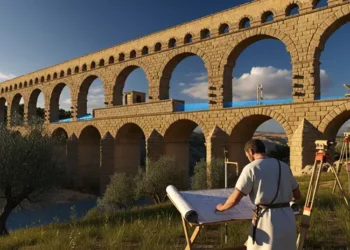


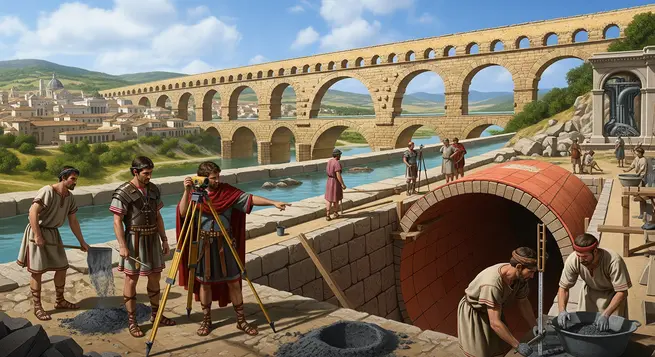
Ancient Roman aqueducts are masterworks of engineering that supplied massive cities with fresh water. Though built centuries ago, many of their design principles still influence modern infrastructure today.
This quiz looks at the technical details behind these structures. You will see questions about surveying instruments, water-proofing mixtures, and the precise gradients required to keep water flowing over long distances.
Once you finish, you can also browse our trivia on ancient engineering, look at iconic monuments, or discover historic places around the globe.
What is the name of the covered channel or conduit through which water actually flowed inside a Roman aqueduct?
Castellum
Castellum
Piscina
Piscina
Specus
Specus
Fistula
Fistula
What was the primary force used to move water through Roman aqueducts?
Water wheels
Water wheels
Electric pumps
Electric pumps
Steam power
Steam power
Gravity
Gravity
In which modern-day country is the famous three-tiered Pont du Gard aqueduct bridge located?
Italy
Italy
Spain
Spain
Greece
Greece
France
France
What is a key construction feature of the Roman aqueduct bridge in Segovia, Spain?
Unmortared stone blocks held by friction and gravity
Unmortared stone blocks held by friction and gravity
Wood and iron scaffolding remains
Wood and iron scaffolding remains
Reinforced concrete pylons
Reinforced concrete pylons
Granite blocks held by mortar
Granite blocks held by mortar
What vital building material, often mixed with volcanic ash, did Romans use to waterproof the interior channels of their aqueducts?
Limestone slabs
Limestone slabs
Clay tiles
Clay tiles
Concrete
Concrete
Lead sheets
Lead sheets
When a valley was too deep to bridge, what technique did Roman engineers often use to keep water flowing?
Deep tunnels cut into mountainsides
Deep tunnels cut into mountainsides
Siphon pipes to cross valleys
Siphon pipes to cross valleys
Large water towers to store pressure
Large water towers to store pressure
Steam-powered lifts to boost flow
Steam-powered lifts to boost flow
Constructed in 312 BC, what was the name of the first aqueduct built to supply Ancient Rome?
Aqua Appia
Aqua Appia
Aqua Virgo
Aqua Virgo
Aqua Claudia
Aqua Claudia
Aqua Traiana
Aqua Traiana
What surveying instrument, featuring a cross with plumb lines, was used by Roman engineers to align straight lines and right angles?
Astrolabe
Astrolabe
Groma
Groma
Sextant
Sextant
Compass
Compass
What was the primary function of a “limaria” found along the route of an aqueduct?
A specialized valve system to control velocity
A specialized valve system to control velocity
A basin used to slow water and settle out sand or debris
A basin used to slow water and settle out sand or debris
A large reservoir used to feed public fountains
A large reservoir used to feed public fountains
A vertical shaft meant for cleaning the tunnel
A vertical shaft meant for cleaning the tunnel
Which administrative office was responsible for the maintenance and management of Rome’s water supply system?
The Curators of Water (Curatores Aquarum)
The Curators of Water (Curatores Aquarum)
The Senate Public Works Committee
The Senate Public Works Committee
The local municipal guilds
The local municipal guilds
The military legion engineers
The military legion engineers
What was the most critical factor Roman engineers had to maintain over dozens of miles to ensure a steady water flow?
The diameter of the piping system
The diameter of the piping system
The slope of the water channel
The slope of the water channel
The depth of the reservoir at the source
The depth of the reservoir at the source
The hardness of the stone used in the arches
The hardness of the stone used in the arches
While gradients varied, what is considered a typical, very precise average gradient for many Roman aqueducts over long distances?
1:10000
1:10000
1:500
1:500
1:5000
1:5000
1:2000
1:2000
Which of the following methods was used by Roman engineers to fracture and excavate hard rock when tunneling for aqueducts?
Heating the rock with fire and rapidly cooling it with water
Heating the rock with fire and rapidly cooling it with water
Dissolving the stone with highly concentrated sulfuric acid
Dissolving the stone with highly concentrated sulfuric acid
Detonating early forms of black powder
Detonating early forms of black powder
Using steam-powered drilling machines
Using steam-powered drilling machines
During the height of the Empire, which of the following consumed the largest portion of the water brought into Rome?
Public baths (thermae)
Public baths (thermae)
Public drinking fountains (lacus)
Public drinking fountains (lacus)
Private households and estates
Private households and estates
Industrial milling of grain
Industrial milling of grain
Which aqueduct was historically praised by Pliny the Elder for the exceptional coldness and purity of its water?
Aqua Anio Novus
Aqua Anio Novus
Aqua Julia
Aqua Julia
Aqua Marcia
Aqua Marcia
Aqua Claudia
Aqua Claudia
What material was primarily used for the distribution pipes that carried water from the city’s header tanks (castellum) to private homes and fountains?
Lead pipes (fistulae)
Lead pipes (fistulae)
Wrought iron piping
Wrought iron piping
Wood-lined stone gutters
Wood-lined stone gutters
Baked clay (terracotta) pipes
Baked clay (terracotta) pipes
What was the term for the distribution tank at the end of an aqueduct line that split water into various streams for city use?
Castellum divisorium
Castellum divisorium
Siphon bridge
Siphon bridge
Aquaeductus minor
Aquaeductus minor
Cisternae maxima
Cisternae maxima
What made the Gier aqueduct near Lyon, France, particularly distinct among Roman hydraulic works?
It utilized a pressurized siphon system to cross the valley floor
It utilized a pressurized siphon system to cross the valley floor
It was built over an active underground volcanic rift
It was built over an active underground volcanic rift
It was entirely constructed of hand-carved marble
It was entirely constructed of hand-carved marble
It is the only Roman bridge that spanned the English Channel
It is the only Roman bridge that spanned the English Channel
Which site, associated with Nero’s villa, features the remains of what are considered the highest dams built by the Romans?
Val-d’Isère dam ruins
Val-d’Isère dam ruins
Subiaco dam ruins
Subiaco dam ruins
Cornalvo dam structure
Cornalvo dam structure
Marib dam ruins
Marib dam ruins
Why were the majority of Roman aqueduct routes built underground rather than on elevated arches?
To prevent algae growth and contamination by birds or debris
To prevent algae growth and contamination by birds or debris
To allow for easier repair of arches during flooding
To allow for easier repair of arches during flooding
To protect the structure from earthquake damage
To protect the structure from earthquake damage
To increase the water pressure throughout the entire line
To increase the water pressure throughout the entire line
What was the primary functional benefit of using monumental arched bridges in aqueduct construction?
The arches were used to support city fortifications
The arches were used to support city fortifications
The arches served as a base for monumental statues
The arches served as a base for monumental statues
The arches were built to impress citizens with the height of the structures
The arches were built to impress citizens with the height of the structures
The arches helped maintain the water’s elevation across depressions in the terrain
The arches helped maintain the water’s elevation across depressions in the terrain
What is the name of the specific hydraulic cement-like plaster used by Romans to seal water channels?
Tallow and crushed charcoal mixture
Tallow and crushed charcoal mixture
Vitrified earthenware lining
Vitrified earthenware lining
Opus signinum (mortar with crushed brick/pottery)
Opus signinum (mortar with crushed brick/pottery)
Bitumen sealer
Bitumen sealer
You can do better
Not bad
Great!
If you enjoyed this, check out our quizzes on architecture, UNESCO sites, and other famous buildings.