

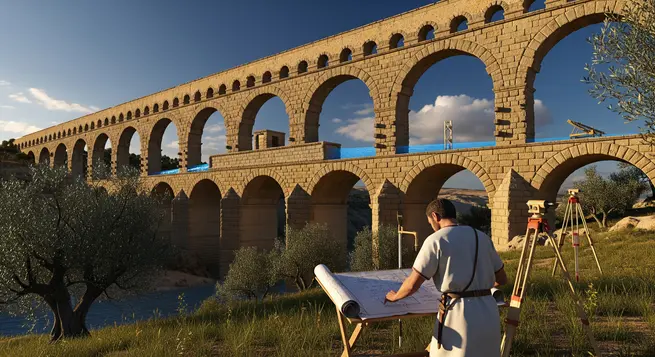

Ancient Roman engineering transformed public utility systems, setting a benchmark for centuries to come. This quiz explores how they constructed their massive, enduring water networks.
You will see questions about gradient calculations, essential survey tools, and the durable materials used in builders’ mortars. Some of the trivia looks at famous monuments, while other facts test your knowledge on underground pipelines.
After you finish, explore our quizzes on bridges and engineering, learn about vintage architectural details, or visit ancient historic places around the globe.
What was the primary method used by Roman engineers to move water through aqueducts?
Steam-powered pumps
Steam-powered pumps
High-pressure pipe systems
High-pressure pipe systems
Water wheel power generation
Water wheel power generation
Gravity and precise gradients
Gravity and precise gradients
What were the primary building materials used in the construction of major Roman aqueduct arches?
Concrete, stone, and lime mortar
Concrete, stone, and lime mortar
Limestone and granite
Limestone and granite
Reinforced steel and lead
Reinforced steel and lead
Clay brick and timber
Clay brick and timber
In which modern-day country is the famous three-tiered Pont du Gard aqueduct situated?
France
France
Spain
Spain
Italy
Italy
Greece
Greece
What was the primary function of a Roman ‘castellum divisorium’?
To measure the purity of the water source
To measure the purity of the water source
To distribute water to different parts of the city
To distribute water to different parts of the city
To filter sediment and silt out of the flow
To filter sediment and silt out of the flow
To increase water pressure for decorative fountains
To increase water pressure for decorative fountains
For what unique construction technique is the Aqueduct of Segovia most notable?
Stacked marble columns
Stacked marble columns
Fired clay pipe sections
Fired clay pipe sections
Granite blocks without mortar
Granite blocks without mortar
Cast iron beams
Cast iron beams
Mountain ranges in which region provided the primary water sources for the city of Rome?
Alps
Alps
Vesuvius
Vesuvius
Etna
Etna
Apennines
Apennines
What primary tool did Roman surveyors use to achieve the necessary straight lines and right angles for aqueduct construction?
Groma
Groma
Sextant
Sextant
Theodolite
Theodolite
Compass
Compass
What was the range of the typical gradient (slope) maintained by Roman engineers for the flow of water?
2.0% to 3.5% grade
2.0% to 3.5% grade
0.6% to 1.5% grade
0.6% to 1.5% grade
4.0% to 5.5% grade
4.0% to 5.5% grade
0.02% to 0.5% grade
0.02% to 0.5% grade
Which Roman Emperor oversaw a massive expansion of Rome’s water supply system, including the construction of the Aqua Julia?
Domitian
Domitian
Hadrian
Hadrian
Tiberius
Tiberius
Augustus
Augustus
Why were the majority of Roman aqueducts built underground or covered by stone slabs?
To keep the water flowing at a high velocity
To keep the water flowing at a high velocity
To stop evaporation and contamination
To stop evaporation and contamination
To make the construction process faster and cheaper
To make the construction process faster and cheaper
To allow sunlight to purify the water naturally
To allow sunlight to purify the water naturally
What was a persistent maintenance challenge for Roman hydraulic systems that required regular manual cleaning?
Internal structural collapse
Internal structural collapse
Lead pollution
Lead pollution
Destruction by earthquake
Destruction by earthquake
Blockages from lime deposits
Blockages from lime deposits
The Pont du Gard was constructed to supply water to which ancient Roman city?
Merida, Spain
Merida, Spain
Nimes, France
Nimes, France
Tarragona, Spain
Tarragona, Spain
Segovia, Spain
Segovia, Spain
Roman hydraulic concrete was famous for its durability, achieved by adding which key ingredient?
A quick-setting gypsum paste
A quick-setting gypsum paste
A mixture of lime, volcanic ash (pozzolana), and water
A mixture of lime, volcanic ash (pozzolana), and water
A lead-based ceramic glaze
A lead-based ceramic glaze
A mixture of resin and animal fat
A mixture of resin and animal fat
The Barbegal aqueduct and mill complex in France was primarily designed for which purpose?
The replenishment of the public fountains and sewage systems
The replenishment of the public fountains and sewage systems
The cooling of the city’s markets
The cooling of the city’s markets
The operation of large-scale water-powered grain mills
The operation of large-scale water-powered grain mills
The water supply for the Emperor’s private baths
The water supply for the Emperor’s private baths
When valleys were too deep for bridges, what technique did Roman engineers use to carry water across?
Tunneling through the center of the valley
Tunneling through the center of the valley
Siphonage through pressurized pipes
Siphonage through pressurized pipes
Consecutive arches spanning the valley floor
Consecutive arches spanning the valley floor
Giant waterwheels suspended in rivers
Giant waterwheels suspended in rivers
What was the name of the first aqueduct built in Rome in 312 BC?
The Aqua Anio Vetus
The Aqua Anio Vetus
The Aqua Claudia
The Aqua Claudia
The Aqua Appia
The Aqua Appia
The Aqua Tepula
The Aqua Tepula
Approximately what is the maximum height of the Aqueduct of Segovia at its highest point?
40 meters
40 meters
46 meters
46 meters
34 meters
34 meters
28 meters
28 meters
Which leveling instrument, consisting of a wooden trough filled with water, was essential for measuring the slope of an aqueduct?
Groma
Groma
Libella
Libella
Chorobates
Chorobates
Dioptra
Dioptra
What were the common pipe materials used for inverted siphons in Roman aqueduct engineering?
Concrete or glass
Concrete or glass
Bronze or iron
Bronze or iron
Lead or terracotta
Lead or terracotta
Wood or leather
Wood or leather
During the siege of Rome in 537 AD, which group famously cut the aqueducts, causing the water supply to the city to fail?
The Byzantines
The Byzantines
The Vitruvian Society
The Vitruvian Society
The Vandals
The Vandals
The Goths
The Goths
What were ‘putei’ in the context of Roman underground aqueduct construction?
Maintenance shafts spaced at regular intervals along the route
Maintenance shafts spaced at regular intervals along the route
A system of secondary wind-powered pumps to restart flow
A system of secondary wind-powered pumps to restart flow
Backup reservoirs kept at the start of each arched bridge section
Backup reservoirs kept at the start of each arched bridge section
Subterranean pressure relief valves made of iron
Subterranean pressure relief valves made of iron
To prevent water leakage within the stone channels of an aqueduct, what specialized lining was applied?
Polished marble facing
Polished marble facing
Opus signinum (waterproof lining)
Opus signinum (waterproof lining)
Gold-leaf sealing
Gold-leaf sealing
Vitrification of stone surfaces
Vitrification of stone surfaces
You can do better
Not bad
Great!
Find more quizzes on architecture, try a game on famous landmarks, or read about ancient urban design.