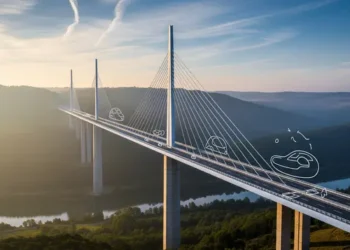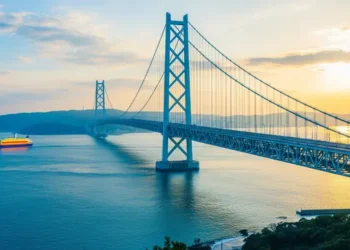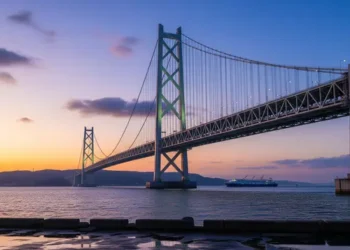


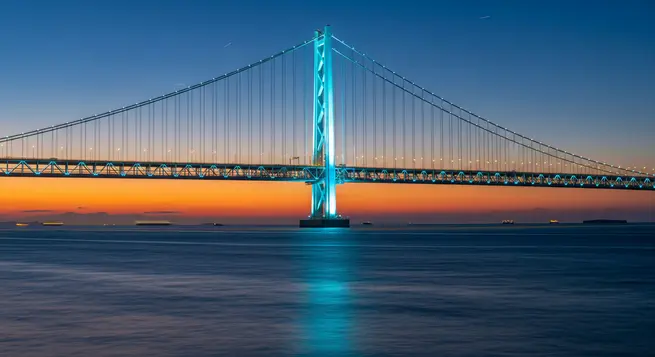
Spanning the Akashi Strait in Japan, the Akashi Kaikyō Bridge is a marvel of modern engineering. This structure connecting Kobe to Awaji Island faced extreme natural trials even during its construction.
This quiz covers the design decisions, seismic engineering, and surprising history of this suspension bridge. You will see questions about its exact dimensions and how it survived the 1995 Kobe earthquake.
Once you finish, you can also explore our quizzes on bridges and engineering, learn about famous landmarks, or check out our trivia on famous buildings around the world.
What is the length of the central span of the Akashi Kaikyō Bridge?
1,991 meters
1,991 meters
1,891 meters
1,891 meters
2,191 meters
2,191 meters
2,091 meters
2,091 meters
The Akashi Kaikyō Bridge provides a vital transportation link between which two main Japanese islands?
Honshu and Kyushu
Honshu and Kyushu
Honshu and Shikoku
Honshu and Shikoku
Honshu and Hokkaido
Honshu and Hokkaido
Shikoku and Kyushu
Shikoku and Kyushu
When discussing a suspension bridge’s world record status, what specific metric is most commonly measured?
Total length of the bridge
Total length of the bridge
Weight of the steel cables
Weight of the steel cables
Height of the bridge towers
Height of the bridge towers
Length of the central span
Length of the central span
In what year was the Akashi Kaikyō Bridge officially opened to traffic?
1998
1998
2000
2000
1996
1996
1994
1994
Which major seismic event directly impacted the construction of the bridge in 1995?
The Kumamoto Earthquake
The Kumamoto Earthquake
The Tohoku Earthquake
The Tohoku Earthquake
The Chuetsu Earthquake
The Chuetsu Earthquake
The Great Hanshin Earthquake
The Great Hanshin Earthquake
As a result of the 1995 earthquake, the distance between the two main towers of the bridge increased by approximately how much?
0.5 meters
0.5 meters
1.1 meters
1.1 meters
0.8 meters
0.8 meters
1.4 meters
1.4 meters
Why was earthquake resistance a primary design consideration for the Akashi Kaikyō Bridge even before the 1995 disaster?
Construction workers were on strike
Construction workers were on strike
Steel production plants were destroyed
Steel production plants were destroyed
Funding was diverted to emergency relief projects
Funding was diverted to emergency relief projects
The bridge location is near a major fault line
The bridge location is near a major fault line
What type of stiffening structure was used to allow the bridge deck to withstand high winds and seismic activity?
Hinged design
Hinged design
Rigid box girder construction
Rigid box girder construction
Concrete-filled steel pipe towers
Concrete-filled steel pipe towers
Truss stiffening girder system
Truss stiffening girder system
Which engineering philosophy allows the Akashi Kaikyō Bridge to survive both massive earthquakes and frequent typhoons?
It is designed to absorb energy through movement
It is designed to absorb energy through movement
It features a massive counterweight system under the sea
It features a massive counterweight system under the sea
It sits on bedrock foundations
It sits on bedrock foundations
It is built entirely from flexible carbon fiber
It is built entirely from flexible carbon fiber
What is the approximate clearance height of the bridge deck above the water level?
65 meters
65 meters
55 meters
55 meters
45 meters
45 meters
75 meters
75 meters
How did engineers respond to the displacement of the towers caused by the 1995 earthquake?
The spans were adjusted, and the superstructure was extended to accommodate the shift
The spans were adjusted, and the superstructure was extended to accommodate the shift
The bridge was abandoned and a tunnel was built instead
The bridge was abandoned and a tunnel was built instead
The anchorages were moved five kilometers inland
The anchorages were moved five kilometers inland
They were scrapped and rebuilt longer
They were scrapped and rebuilt longer
What advanced technology is installed inside the towers to act as motion-dampening devices during strong winds or tremors?
Dampers using pendulums
Dampers using pendulums
Hydraulic shock absorbers
Hydraulic shock absorbers
Rubber bearings
Rubber bearings
Lead-rubber isolators in the piers
Lead-rubber isolators in the piers
Which city on Honshu island does the bridge connect to Awaji Island?
Osaka
Osaka
Kyoto
Kyoto
Kobe
Kobe
Hiroshima
Hiroshima
What is the exact length of the central span of the Akashi Kaikyō Bridge?
1,990 meters
1,990 meters
1,992 meters
1,992 meters
1,991 meters
1,991 meters
1,989 meters
1,989 meters
Why is the bridge deck designed to be relatively porous to wind?
To allow large cruise ships to pass under the main span at high speed
To allow large cruise ships to pass under the main span at high speed
To facilitate easier maintenance of the structural integrity lights
To facilitate easier maintenance of the structural integrity lights
To reduce the wind load on the structure
To reduce the wind load on the structure
To maintain aesthetics for tourism
To maintain aesthetics for tourism
What material choice was critical for the main bridge cables to ensure high strength and corrosion resistance?
Carbon-fiber reinforced cables
Carbon-fiber reinforced cables
Multi-strand titanium rods
Multi-strand titanium rods
High-tensile galvanized wire bundles
High-tensile galvanized wire bundles
Prestressed concrete cables
Prestressed concrete cables
What type of vehicular transport is the bridge primarily designed to support?
Both public rail tracks and pedestrian walkways
Both public rail tracks and pedestrian walkways
A high-speed six-lane motorway
A high-speed six-lane motorway
A dedicated bicycle path only
A dedicated bicycle path only
The Shinkansen (Bullet Train) rail lines
The Shinkansen (Bullet Train) rail lines
What is the maximum earthquake magnitude on the Richter scale that the bridge was designed to withstand?
9.0
9.0
7.5
7.5
8.5
8.5
8.0
8.0
What is the name of the specific fault line whose movement caused the 1995 earthquake and impacted the bridge construction?
The San Andreas Fault
The San Andreas Fault
The Median Tectonic Line
The Median Tectonic Line
The Nojima Fault
The Nojima Fault
The Itoigawa-Shizuoka Tectonic Line
The Itoigawa-Shizuoka Tectonic Line
Approximately how much steel wire was used to create the bridge’s two main cables?
250,000 kilometers of wire
250,000 kilometers of wire
350,000 kilometers of wire
350,000 kilometers of wire
300,000 kilometers of wire
300,000 kilometers of wire
200,000 kilometers of wire
200,000 kilometers of wire
How were the enormous foundations for the main towers placed in the strait?
They were constructed using massive driven steel piles and precast concrete caps
They were constructed using massive driven steel piles and precast concrete caps
They were constructed by towing giant, hollow steel caissons to the site, submerging them, and filling them with concrete
They were constructed by towing giant, hollow steel caissons to the site, submerging them, and filling them with concrete
They were anchored directly into loose seabed sand using suction piles
They were anchored directly into loose seabed sand using suction piles
They were built by freezing the surrounding seabed to create a temporary ice-shield
They were built by freezing the surrounding seabed to create a temporary ice-shield
Because of the illumination system used on the bridge at night, what is its popular nickname?
The “Sun Pillar”
The “Sun Pillar”
The “Iron Dragon”
The “Iron Dragon”
The “Sea Gate”
The “Sea Gate”
The “Pearl Bridge”
The “Pearl Bridge”
You can do better
Not bad
Great!
If you enjoyed this, try our quizzes on skyscrapers and towers, discover urban design concepts, or browse these travel curiosities.