

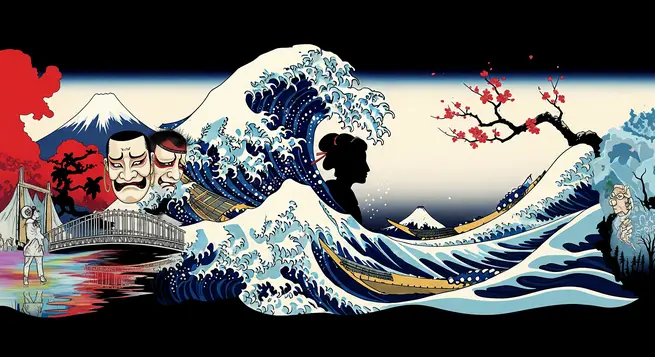
This trivia quiz explores the rich history of Japanese ukiyo-e woodblock prints, focusing on the techniques, master artists, and historical legacy of the “floating world.”
You will see questions about the printmaking process, traditional materials, and iconic masterpieces. The quiz also covers how these distinctive works influenced famous Western painters.
When you finish, check out our other quizzes on visual art, learn about noted creators, or see how styles evolved through global movements.
What is the literal translation of the Japanese term ‘ukiyo’?
Floating World
Floating World
Ancient Paths
Ancient Paths
Silent Shadows
Silent Shadows
Rising Sun
Rising Sun
What is the primary artistic medium used to create traditional ukiyo-e prints?
Stone lithography
Stone lithography
Woodblock carving
Woodblock carving
Charcoal sketching
Charcoal sketching
Oil paint
Oil paint
In which historical city did the ukiyo-e movement primarily flourish during the Tokugawa period?
Osaka
Osaka
Nara
Nara
Edo
Edo
Kyoto
Kyoto
Which subject was a common and popular theme in early ukiyo-e prints?
The beauty of geisha culture
The beauty of geisha culture
International political relations
International political relations
The harsh realities of rural life
The harsh realities of rural life
The architectural history of temples
The architectural history of temples
Which iconic work by Katsushika Hokusai features Mount Fuji in the background behind a towering crest of water?
The Great Wave off Kanagawa
The Great Wave off Kanagawa
The Red Fuji
The Red Fuji
Stormy Night at Sumida
Stormy Night at Sumida
The Waterfall at Yoro
The Waterfall at Yoro
What is the primary function of the ‘kento’ marks in the traditional Japanese woodblock printing process?
Rubbing the back of the paper to transfer ink
Rubbing the back of the paper to transfer ink
Aligning the paper across multiple color blocks
Aligning the paper across multiple color blocks
Applying ink evenly onto the woodblock
Applying ink evenly onto the woodblock
Softening the wood before carving begins
Softening the wood before carving begins
Which type of wood is traditionally preferred for carving the blocks used in ukiyo-e printing due to its hardness and fine grain?
Balsa wood
Balsa wood
Oak wood
Oak wood
Cherry wood
Cherry wood
Pine wood
Pine wood
The ukiyo-e subgenre known as ‘yakusha-e’ primarily focuses on which of the following subjects?
Kabuki actors
Kabuki actors
Beautiful women
Beautiful women
Historical landscapes
Historical landscapes
Sumo wrestlers
Sumo wrestlers
Utagawa Hiroshige is famous for a series of landscape prints depicting scenes along which major travel route?
The Fifty-three Stations of the Tōkaidō
The Fifty-three Stations of the Tōkaidō
The Forty-five Stations of the Kōshū Kaidō
The Forty-five Stations of the Kōshū Kaidō
The Twenty-one Stations of the Nikkō Kaidō
The Twenty-one Stations of the Nikkō Kaidō
The Sixty-nine Stations of the Nakasendō
The Sixty-nine Stations of the Nakasendō
Which innovative compositional technique is Utagawa Hiroshige famously known for in his late landscape series?
Depicting subjects solely through solid black silhouette shapes
Depicting subjects solely through solid black silhouette shapes
Juxtaposing large foreground elements with distant background scenes
Juxtaposing large foreground elements with distant background scenes
Using European-style single-point linear perspective exclusively
Using European-style single-point linear perspective exclusively
Adhering strictly to symmetrical layouts with a centered subject
Adhering strictly to symmetrical layouts with a centered subject
Hiroshige’s landscape prints are particularly noted for his mastery in capturing what?
Atmospheric conditions like rain and snow
Atmospheric conditions like rain and snow
Abstract portraits of royalty
Abstract portraits of royalty
Western-style geometric shapes
Western-style geometric shapes
Paper grain textures
Paper grain textures
In the traditional ukiyo-e production team, who was responsible for financing the project and selecting the designs?
The printer
The printer
The paper maker
The paper maker
The woodcutter
The woodcutter
The publisher
The publisher
Which synthetic pigment, introduced to Japan in the 19th century, became famously associated with Hokusai’s landscapes?
Emerald green
Emerald green
Prussian blue
Prussian blue
Royal purple
Royal purple
Venetian red
Venetian red
What was the ‘hanshita-e’ in the context of the ukiyo-e printing process?
The frame used to register multiple color blocks
The frame used to register multiple color blocks
The tool used to rub ink into the paper
The tool used to rub ink into the paper
The preparatory drawing pasted onto the woodblock for carving
The preparatory drawing pasted onto the woodblock for carving
The finished multi-colored print
The finished multi-colored print
How were ukiyo-e prints generally distributed in 19th-century Japan?
They were mass-produced and affordable for commoners
They were mass-produced and affordable for commoners
They were discarded after a single use
They were discarded after a single use
They were only sold through royal decree
They were only sold through royal decree
They were exclusive to the wealthy elite
They were exclusive to the wealthy elite
Which French art critic coined the term ‘Japonisme’ in 1872?
Charles Baudelaire
Charles Baudelaire
Philippe Burty
Philippe Burty
Émile Zola
Émile Zola
Louis Leroy
Louis Leroy
Which Impressionist painter famously featured a Japanese-style bridge in his garden?
Claude Monet
Claude Monet
Camille Pissarro
Camille Pissarro
Edgar Degas
Edgar Degas
Pierre-Auguste Renoir
Pierre-Auguste Renoir
Which artist copied ukiyo-e prints by Hiroshige in oil paint, notably his version of ‘Plum Park in Kameido’?
Edgar Degas
Edgar Degas
Claude Monet
Claude Monet
Vincent van Gogh
Vincent van Gogh
Paul Cézanne
Paul Cézanne
When European artists were influenced by ukiyo-e, which stylistic element did they frequently adopt?
Complex use of chiaroscuro and light layering
Complex use of chiaroscuro and light layering
Detailed chiaroscuro and vanishing points
Detailed chiaroscuro and vanishing points
Strong, thick outlines and flat color areas
Strong, thick outlines and flat color areas
Heavy impasto and dark shadows
Heavy impasto and dark shadows
How did ukiyo-e influence Western compositional strategies?
High-contrast shadows
High-contrast shadows
Deep, mathematical perspective
Deep, mathematical perspective
Asymmetrical compositions
Asymmetrical compositions
Focus on historical battles
Focus on historical battles
What legacy did the ukiyo-e style leave on Western visual arts?
They provided a blueprint for modern graphic design and poster art
They provided a blueprint for modern graphic design and poster art
They were only used as wrapping paper for tea exports
They were only used as wrapping paper for tea exports
They were forbidden in Japan
They were forbidden in Japan
They were used primarily for religious texts
They were used primarily for religious texts
Which artist famously created the ‘Thirty-six Views of Mount Fuji’ series featuring the iconic print ‘The Great Wave off Kanagawa’?
Katsushika Hokusai
Katsushika Hokusai
Toshusai Sharaku
Toshusai Sharaku
Utagawa Hiroshige
Utagawa Hiroshige
Kitagawa Utamaro
Kitagawa Utamaro
You can do better
Not bad
Great!
Ready for more? Try our quizzes on picturesque landscapes, visit legendary historic sites, or discover traditional classical techniques.